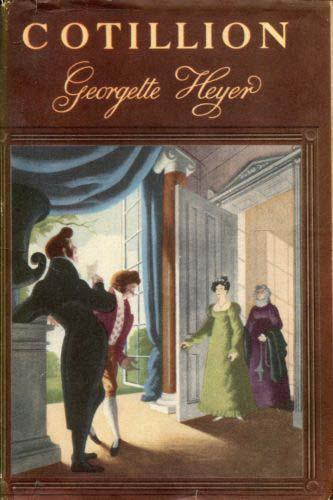
Kitty Charing needs a fiancé — specifically, she needs to appear engaged convincingly enough to make the man she is actually in love with take notice and propose before she leaves London for good. Her cousin Freddy Standen seems like the obvious choice for the role: agreeable, good-natured, entirely without romantic ambition toward her, and available. Georgette Heyer set up Cotillion as a comedy of romantic errors and delivered something considerably more interesting: a novel about the man who was always supposed to be a convenient fiction becoming, without anyone quite authorizing it, the actual story.
Freddy Standen is not the obvious romantic hero. He is not brooding, not dangerous, not in possession of a tragic past or a smoldering gaze. He is fashionable, affable, good at knowing exactly which waistcoat is appropriate for which occasion, and possessed of a social intelligence that reads as frivolity until you watch him deploy it. Heyer understood something that the Regency romance genre has sometimes lost in the decades since: the man who is kind in the specific, practiced, unspectacular way — who is consistently decent without drama, who pays attention without announcement — is quietly the most reliable romantic lead available. Freddy is that man, and Cotillion is his vindication.
Kitty’s pursuit of the wrong man is rendered with full sympathy and genuine comedy. She is not foolish — she is inexperienced, and the man she thinks she wants presents as everything she has been told to want. What she does not yet know, and what the reader sees well before she does, is that the qualities she is performing a romance with are not the qualities that will actually make her happy. Freddy is not a consolation prize. He is the answer to a question she did not know she was asking. Heyer makes the reader feel this before Kitty does, which creates the particular pleasure of watching someone walk toward the right thing without realizing they have turned around.
Heyer’s Regency world is one of the great pleasures of historical romance, and Cotillion is among her most purely enjoyable entries — warmer than some, more comedic than others, and in Freddy a hero who has no precedent in the genre and has not been successfully replicated since. Readers who love Frederica will find a different kind of reluctant hero here — where Alverstoke is guarded, Freddy is simply underestimated, and the romance works through the same mechanism of a woman finally seeing what has been in front of her the entire time.
For readers who love the fake-engagement structure in a Regency setting, The Duke and I by Julia Quinn is the modern equivalent — same mechanism, more heat, more explicit emotional processing from both parties. The comparison is instructive: Heyer trusts the subtext to carry the romance without naming it until the final pages, and the restraint is itself a pleasure. Quinn’s version makes the feelings visible earlier and develops them more directly, which satisfies a different kind of reader. Both approaches are correct; they are just different conversations with the same genre tradition.
Freddy agreed to play a role. He was supposed to be a fiction that served Kitty’s purposes and nothing more. He played the role so well — with such genuine attention, such quiet reliability, such complete lack of pretense — that it stopped being a role and became simply who he was, with her. That is the arc of Cotillion, told with Heyer’s dry wit and enormous warmth, and it is one of the most satisfying turns in Regency romance.
Heyer’s catalog is large and the quality is remarkably consistent — nearly all of her Regency titles reward reading, and the reader who falls into her world tends to want to stay. For a suggested reading path: Frederica and Cotillion together offer the two versions of her reluctant-hero romance at their finest. The Grand Sophy offers her most formidable heroine. A Civil Contract is her most emotionally complex and least typical work — a marriage-of-convenience story that does not end the way most romance readers expect, but that is perhaps the most honest thing she ever wrote about love.
A final note on Heyer’s legacy: she essentially created the Regency romance genre as it exists, and writers from Julia Quinn to Loretta Chase to Mary Balogh have all named her as foundational to their work. Reading her is not just reading a historical romance — it is reading the source code of the genre. That context enriches rather than burdens the experience; it explains why certain conventions feel like conventions rather than invention, and it gives the reader a way to understand what each subsequent writer chose to keep, extend, or deliberately subvert. Cotillion is an excellent place to discover why.