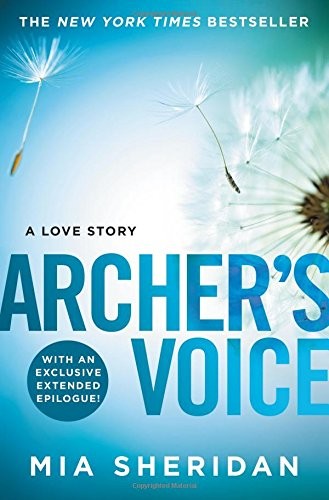
Driving until you cannot anymore is its own kind of decision — the miles doing the deciding when you cannot. Bree drove to Archer’s Creek, Montana because the map ended there and she had nowhere left to go that was not a retreat. She did not expect to stay. She did not expect the man at the edge of town who barely spoke, who worked his land mostly alone, whose silence was specific and chosen rather than simple shyness. She did not expect any of it. Mia Sheridan built Archer’s Voice on what happens when the woman who has been running arrives at the place that asks her to stop.
Archer Hale has selective mutism — a trauma response that has left him largely nonverbal with strangers, comfortable only with the people he trusts completely, which is a very short list. He lives at the edge of town, keeps to himself, and has accommodated his world to his voice’s limits rather than fighting them. Bree arrives in Archer’s Creek not knowing any of this, and encounters a man who communicates differently than anyone she has met before — through gesture, through presence, through a quality of attention that is more thoroughgoing than most people manage with a full vocabulary. Their connection develops in that space, through the specific intimacy of two people learning each other’s language.
Sheridan understands that a love story built around a communication difference only works if both characters are given equal interiority. Archer is not a puzzle for Bree to solve or a project for her to undertake. He is a man with a specific history, specific wounds, specific pleasures and preferences and opinions, who happens to express them differently than the reader might expect. Bree’s willingness to learn his language rather than requiring him to perform hers is the romantic act of the book — not a grand gesture but a sustained attentiveness that Sheridan renders with real warmth.
The Montana setting is load-bearing in the same way that all good small-town romance settings are: it creates the conditions for unavoidable proximity and removes the social exits that would allow both characters to keep their distance. The land itself has a texture that Sheridan renders with care, and the seasons create a natural rhythm for the slow development of what builds between Archer and Bree. By the time the obstacles arrive — and they do — the reader has spent enough time in this world to feel the specific stakes of what might be lost.
Sheridan’s back catalog is worth exploring for readers who connected with the quality of patience and emotional precision in this book. Her titles tend toward the slow-burn, the quietly wounded hero, and the heroine who is doing her own healing alongside the romance. Leo and Grayson’s Vow are frequently cited alongside Archer’s Voice as her strongest works — different settings and dynamics, the same essential warmth.
For readers who love the small-town accidental-life story, Things We Never Got Over by Lucy Score runs the same basic mechanism at higher temperature and with considerably more comedy. For the wounded hero who communicates differently — whose emotional world is fully present but not easily accessible — Heartless by Elsie Silver offers a man whose damage is verbal and emotional rather than neurological, with the same quality of requiring the right person’s patience to reach what is underneath.
Archer did not ask her to stay. He did not have the words for it, or rather, he had words but not the practice of using them for something this large. What he had was presence — consistent, specific, completely attentive in a way that Bree had not experienced before and did not know how to leave behind. Archer’s Voice is a love story about the particular intimacy of being seen by someone who takes the time to look properly, and about the woman who stayed long enough to be seen in return.
The audiobook deserves a specific mention: Archer’s Voice is one of the more thoughtfully narrated romances in this space, and the way Archer’s silence is rendered — the pauses, the quality of attention that fills the space where words would be — is something the audio format delivers particularly well. For readers who have not tried this one in audio, it is worth the experiment.