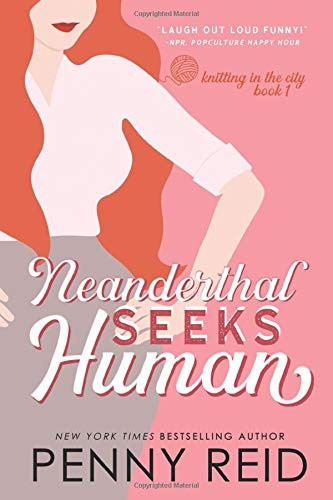
Romance heroines are rarely allowed to be eccentric. They are allowed to be bookish, occasionally clumsy, professionally competent in nonthreatening ways — but genuinely, specifically odd, in ways that make other people in the narrative slightly puzzled by them? That is rarer. Penny Reid’s Neanderthal Seeks Human opens with a heroine who is firing facts about textile history at strangers while being escorted out of her former workplace by security, and it treats this quality as the most appealing thing about her rather than a character flaw to be corrected. That choice is the foundation of everything the Knitting in the City series does right.
Janie Morris processes the world through information. When she is stressed, she narrates obscure historical trivia. When she is attracted to someone, she compares them to various epochs of human development (hence the title). When she is uncertain about a social situation, she delivers what the people around her experience as non sequiturs and what she experiences as perfectly logical responses to the actual substance of what is happening. Reid writes Janie’s interiority with genuine affection, and the result is a heroine who feels specifically, unusually real in ways that more conventionally drawn romance heroines rarely achieve.
Quinn Sullivan is the kind of hero who reads differently as the book progresses — patient, specific in his attention to Janie, and possessed of a professional identity that is not what it initially appears to be. The slow reveal of who he actually is, done in stages that reflect Janie’s gradual attention rather than a dramatic twist, is one of the structural pleasures of the book. Their dynamic is built on the specific quality of his finding her genuinely interesting rather than finding her eccentricity something to be managed or indulged, which is the only thing that would work for a heroine like Janie and the only thing that should work for a reader who likes her.
The Knitting in the City series follows a friend group of women who are all specific and odd in their own ways, and the series is best read in order for the full enjoyment of the community. Each book features a different central couple, but the friendships are as central to the emotional landscape as the romances — which is relatively rare in contemporary romance and entirely in keeping with what this series is doing. The found family is a group of women who found each other, and the warmth of that community gives each individual love story room to breathe.
For readers who loved the geek-heroine appeal of The Kiss Quotient and want more of that specific pleasure — the heroine who operates on a different social frequency than the world around her and the hero who finds that frequency the one worth being on — this is a very natural next read. The audiobook production for the Knitting in the City series has a warmth that suits the close ensemble structure; Janie’s internal voice is one of the more memorable in the subgenre when narrated well.
What Reid understands is that the most romantic thing a hero can do is not a grand gesture. It is the consistent small evidence that he has been paying attention to who you actually are. Quinn’s particular quality of attention to Janie is the romance of this book. Everything else is in service of that.