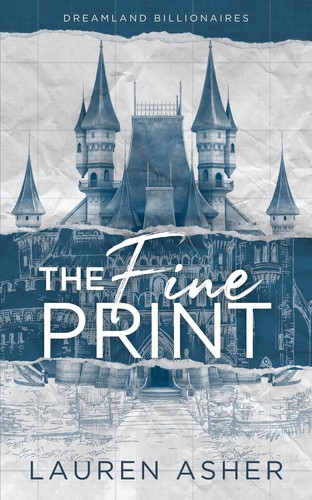
The billionaire romance has a long bibliography, but Lauren Asher found an angle in The Fine Print that distinguishes it from the subgenre’s defaults: instead of a generic corporate setting, the Dreamland theme park empire is built with the specific texture of a place that matters culturally — that functions as shared mythology, that means something particular to the people who love it, and that has a specific kind of magic worth protecting. That context gives the romance’s central conflict a dimension that office romance often misses: the dispute between Rowan and Zahra is not just a power differential. It is a disagreement about what things are worth.
Rowan Kane has inherited the responsibility for a theme park empire from his family and has brought to it the instincts of an efficient businessman: identify what isn’t working, cut it, optimize what remains. Zahra is a creative working in the park’s development team who came to Dreamland as a dream and stayed because it kept being one. The collision of these two approaches — his efficiency and her passion — is the engine of the professional conflict, and Asher builds it with enough specificity that you understand both positions even as you’re clearly aligned with one of them.
The Dreamland Billionaires series is a trilogy, and this first book establishes the world and the central Kane family with the kind of structural investment that makes the subsequent books more emotionally resonant. Asher builds the theme park setting with genuine detail — the behind-the-scenes operations, the creative development process, the corporate politics that govern what gets made — and that detail elevates the setting from a gimmick to a world.
The grumpy/sunshine dynamic is handled with real craft. Rowan’s grumpiness is not petulance — it is the specific coldness of someone who has learned to protect himself through efficiency and now encounters someone whose entire professional value comes from the opposite approach. His adaptation to Zahra is slow and happens through argument rather than conversation, which is somehow more convincing than a more direct thaw would be. She doesn’t try to fix him. She just keeps doing her job very well in his presence until he has to reckon with what that means.
For readers who loved the workplace dynamic in The Hating Game and want something with a more contemporary feel and a more elaborate external world, this series delivers that. The audiobook production gives the theme park setting an almost cinematic quality — the world is big enough to benefit from a narrator who treats it with appropriate scope, and the production does exactly that.
Lauren Asher has built a significant readership with this series and with her subsequent work, and readers who find her here often work through her catalog quickly. Each book in the Dreamland trilogy features one of the Kane brothers and a different corner of the empire, and the interconnected nature of the family drama gives the series a satisfying arc that builds across all three books.
What The Fine Print understands is that the best boss/employee romances are not about power — they are about perspective. Rowan has a lot of power and a very limited perspective. Zahra has no power and can see exactly what he’s missing. The romance is the story of power yielding to perspective, which is not a common narrative and is entirely worth reading.