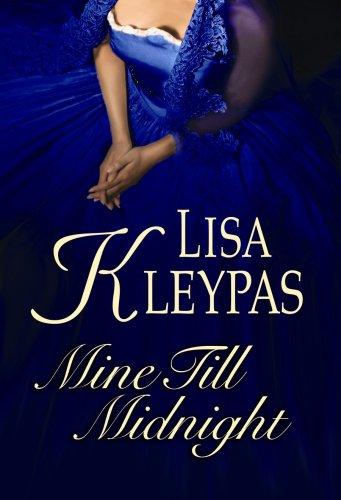
The Hathaway family of Hampshire are not quite what polite Victorian society considers proper, and they have stopped pretending to care. The eldest daughter runs the family with intelligence and quiet authority. The siblings include a brother who studies esoteric philosophy, a sister with a talent for numbers, a sister who befriends wild animals, and a younger brother who is perpetually up to something. Into this unusual household arrives a man with a dangerous past and no particular reason to stay in England — and does not leave. Lisa Kleypas opened her Hathaway series with Mine Till Midnight and gave it a heroine worth building a series around.
Amelia Hathaway is the practical one, the responsible one, the person who holds everything together through sheer competence and will. Cam Rohan is half Romani, half English, carrying the particular displacement of someone who does not fully belong to either world, and who has built a life out of that displacement rather than being undone by it. Kleypas builds their dynamic on mutual recognition — two people who are each other’s most accurate audience, who see past the roles both of them perform for other people. Cam sees Amelia’s exhaustion underneath the capability. She sees his warmth underneath the self-sufficiency. That specific seeing, before either of them has named what is happening, is where the romance lives.
The Romani element in this book is handled with more care and specificity than most historical romance manages with cultural identity. Cam’s relationship to his heritage — the traditions he has kept, the ones he has let go, the way his blood’s pull toward the open road conflicts with the life he has built in London — is not ornamental. It is structural to who he is and to what draws him to the Hathaways, who are their own kind of people who do not quite fit the world they were born into. The parallel is explicit and the book earns it.
Kleypas’s Hathaway series rewards reading in full — each sibling’s story deepens the family as a whole, and the emotional payoffs compound. Seduce Me at Sunrise (Kev and Win) is frequently cited as the series’ emotional peak, and Tempt Me at Twilight delivers the most comedic entry. All of them benefit from the context built in this first book, and the family grows richer with each addition. Starting with Amelia is the right choice — she is the anchor, and the series works best when the reader understands the weight she carries and the relief of finally having someone share it.
For readers who want to stay in Kleypas’s historical world after this series, the Wallflowers quartet offers Devil in Winter and Dreaming of You as essential companions — the same quality of emotional precision and the same gift for heroes who are redeemed by specific recognition rather than general tenderness. Kleypas’s range across historical periods and emotional registers is remarkable, and the Hathaway series is the right starting point for readers who want that range at its most consistent.
Cam Rohan could have left. He had reasons and means and no particular obligation. He stayed because the Hathaways were interesting, he told himself — and because Amelia was interesting, specifically, in ways he had not encountered before. The woman who holds everything together and asks for nothing is a particular kind of irresistible to a man who has spent his life moving. She was the first thing that made him want to stop. Mine Till Midnight is the story of how that wanting grew from interesting into necessary, and Kleypas tells it with the warmth and precision that have made her one of the most trusted names in historical romance for thirty years.
A note on the title’s meaning: Cam’s offer — that Amelia is his until midnight, after which all agreements are renegotiated — is the kind of small structural promise that a Kleypas hero makes and means, and that the reader understands will be renegotiated in only one direction. The title is a quiet joke and a quiet declaration simultaneously, which is exactly the register this book operates in throughout.
The Victorian setting in the Hathaway series is somewhat later than Kleypas’s Wallflowers Regency world, and she uses the difference deliberately — the 1840s give the Hathaways slightly more freedom than the Regency would, and Cam’s position as a gaming club owner sits more comfortably in that later era’s social landscape. The period is not decoration; it’s a structural choice that expands what is possible for these particular characters. That attention to how setting shapes story is one of the things that distinguishes Kleypas’s historical work from writers who treat the period as backdrop rather than architecture.