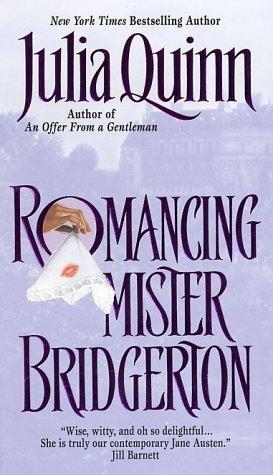
Penelope Featherington spent a decade in London society being invisible. Not literally — she was present at every ball, every dinner, every social occasion her family dragged her to. She simply did not register on anyone’s attention in the way that mattered. She was the plain one, the overlooked one, the Featherington nobody had a use for. She also spent that decade quietly, devotedly, entirely hopelessly in love with Colin Bridgerton — one of the most charming men in London, who had always been kind to her in the specific way of someone who simply does not think of you that way. Julia Quinn built Romancing Mister Bridgerton on what happens when that man finally looks.
The fourth book in the Bridgerton series is widely considered its emotional peak, and the reason is structural: Quinn spent three books making Penelope a reader favorite before giving her the story. By the time Colin finally sees her, the reader has been watching Penelope see herself clearly — her intelligence, her secret life, her capacity for observation — for three books. The revelation lands with force because the reader has been waiting longer than Penelope has, which is the precise condition for that particular payoff.
Colin’s arc is the complementary piece. He has spent years being charming without being deep, likeable without being known, wanted by everyone without wanting anyone specifically. His growth in this book is about finding out that the person who knows him best has been in the same room the entire time. Penelope’s intelligence about him — the way she sees him clearly and loves what she sees with full information — is the thing that finally makes him feel genuinely seen rather than simply admired. Quinn understood that the overlooked woman’s payoff is not just romantic recognition but the specific recognition that her seeing was always accurate.
Lady Whistledown is integral to this book in a way that cannot be discussed without spoilers, but readers who have followed the series know that Penelope’s secret life is load-bearing. What Quinn does with it in this fourth volume is the culmination of something she has been building across the series, and it is one of the more satisfying structural payoffs in romance fiction. The revelation of who Lady Whistledown is — and what it costs Penelope, and what it asks of Colin — gives the romance its real stakes and earns the resolution it delivers.
Quinn’s Bridgerton series rewards reading from the beginning, and Romancing Mister Bridgerton accumulates everything the first three books built — in terms of character familiarity, world texture, and emotional investment — into something richer than it would be as a standalone. The Duke and I is the right starting point; by the time Colin and Penelope’s story arrives, the reader has the context to feel the full weight of what Quinn delivers here.
For readers who love the overlooked heroine finally seen dynamic in historical romance, Dreaming of You by Lisa Kleypas is the essential companion read — Sara Fielding’s plainness and intelligence make her the precise equivalent of Penelope in a slightly earlier period and with a hero who sees her before she expects to be seen, rather than belatedly. Both books understand the same fundamental truth: the woman who was always there deserves a love story that matches how long she waited for someone to notice.
She was never actually invisible. She was simply waiting for the one person whose looking would matter. And Colin Bridgerton spent the better part of a decade standing in the same room, and finally — finally — looked. Romancing Mister Bridgerton is the book Penelope Featherington deserved, and Quinn delivered it at the exact right moment in the series’ arc, with the full weight of everything that came before it pressing down on every page.
A note on the Netflix adaptation: the Bridgerton series adapted this fourth book as its third season, which introduced many readers to Colin and Penelope’s story before they had read the book. The adaptation handles the emotional core well but diverges from Quinn’s structure in ways that matter — particularly around Lady Whistledown’s timeline. Readers who loved the show and come to the book will find more of Penelope’s interior life, more of the specific emotional weight of her decade of invisibility, and a resolution that earns its happiness differently. Both are worth the time.