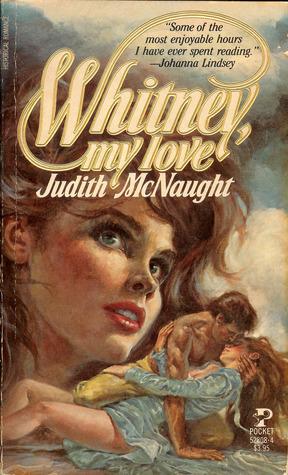
A nostalgia specific to a certain kind of historical romance — big, dramatic, emotionally excessive in the best possible way. The hero who is genuinely terrible at first and has a genuine arc. The heroine who absolutely refuses to be diminished even when the situation seems to demand it. The slow, painful, turbulent journey toward two people who are, in fact, each other’s story. Whitney, My Love by Judith McNaught is one of the defining examples of that tradition, and for a generation of romance readers, it was the beginning of everything.
Clayton Westmoreland is one of the original romance alphas — powerful, arrogant, accustomed to getting exactly what he wants, not particularly troubled by what it costs others. He acquires Whitney Stone in terms that the modern reader will clock immediately, and McNaught does not soften that. Whitney is the heroine who will not cooperate with any of it — not the arrangement, not the expectation, not the assumption that she will eventually fall into line. McNaught builds their dynamic across a long, turbulent arc that asks a great deal of the reader’s patience and then, gradually and with real precision, rewards it.
What makes this book endure — what keeps it findable and still read and still sparking strong reactions decades after its first publication — is McNaught’s understanding of emotional interiority. She writes the inside of both characters with unusual access: you understand every terrible decision, every misunderstanding, every moment where a different choice would have changed everything. That psychological precision is what made McNaught a standard-bearer for the genre in its formative years, and it is what the book continues to offer readers who come to it now.
It is worth being honest with new readers: this is a Golden Era historical romance, written in the 1980s, and some of its dynamics reflect the conventions of that moment in the genre rather than current ones. Readers who approach it knowing this — and knowing that McNaught herself later said she would write certain scenes differently — tend to find more to appreciate in what the book does brilliantly rather than less. The emotional depth, the scale of the arc, and Whitney’s particular brand of stubborn intelligence are genuinely impressive by any era’s standards.
The epic scale of McNaught’s historical romances — the scope of the emotional arc, the richness of the period detail, the sense that these characters’ lives extend beyond the pages of the book — suits audio in a way that matches the grand gesture quality of her storytelling. This is a long book with a long arc, and hearing it gives it room to breathe.
McNaught’s other titles — Something Wonderful, Almost Heaven, A Kingdom of Dreams — are the blueprint for a certain kind of historical romance heroine and hero, and readers who connect with this book tend to work through the catalog. Kingdom of Dreams in particular is frequently cited alongside this one as a McNaught essential. For readers who want the emotional scale of Golden Era romance with somewhat updated dynamics, Julia Quinn’s Bridgerton series offers a warmer, more comedic version of the same period with heroes who are difficult but rarely at Clayton’s extremes.
For a certain generation of romance readers, this book was the beginning — the one that taught them what the genre could do when it committed fully to the emotional stakes. If it was yours, you already know exactly what this means. If it was not, welcome to the origin story. McNaught built something here that held its ground for forty years, and that kind of endurance is its own argument.
McNaught’s gift for making the reader understand a villain-adjacent hero — for rendering his choices as coherent even when they are not defensible — is the skill that made her famous and the skill that Whitney, My Love demonstrates most fully. Clayton is not a sympathetic figure in the early chapters, and McNaught does not ask you to pretend he is. She asks you to stay long enough to see who he becomes, and to understand how Whitney’s refusal to accept less than she deserves is the thing that makes that transformation possible. That is an argument about love and accountability that holds up. It held up in 1985 and it holds up now.