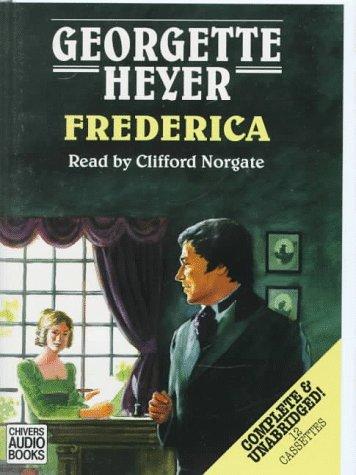
Loving someone who holds themselves responsible for you — who has placed themselves in the category of guardian, protector, the person with obligations toward you that preclude other kinds of feelings — is a specific and patient kind of longing. The restraint on both sides of that arrangement. Him, holding the line because he has decided the line is the right thing. Her, not quite pretending she has not noticed what the line is costing him. The long game that neither of them can quite acknowledge they are playing. Georgette Heyer wrote that long game with the full force of her particular genius in Frederica.
The Marquis of Alverstoke is not a man who takes on responsibilities he did not ask for — he has, in fact, spent his entire adult life avoiding exactly this kind of entanglement. Frederica arrives in his orbit through circumstances that leave him nominally responsible for her family’s London season, which he agrees to with the full intention of being minimally involved. Heyer is merciless in engineering his deeper and deeper investment — through her siblings’ various crises, through her practical capability in handling those crises, through the accumulating evidence that she is, in fact, the most interesting person he has encountered in years. His studied indifference becomes a performance he is increasingly aware of performing, and she has been quietly aware of it all along.
Heyer’s comedy of manners is operating at full capacity here — the dry wit, the social observation, the particular absurdity of the Regency world rendered with affection and precision. But what lifts Frederica above Heyer’s lighter work is the genuine emotional depth of the hero’s transformation. Alverstoke is not softened by love so much as he is surprised by it, caught off guard by a woman who refuses to be managed or impressed, and who thereby forces him to encounter himself without the performance he normally relies on. The surprise is the point. He had organized his life specifically to avoid this kind of feeling, and Frederica outwitted the organization without even trying.
Frederica herself is one of Heyer’s finest heroines. She is capable and practical and entirely focused on her family’s welfare — the romance is, from her perspective, an unexpected complication rather than a goal. That focus makes her more interesting than the standard Regency heroine who is simply waiting to be noticed, because Frederica is busy with other things and notices the Marquis only when his behavior toward her becomes impossible to overlook. Her practical intelligence is what he falls for, and it is what makes the eventual love story feel like a meeting of equals rather than a rescue.
Heyer’s wit requires a voice — the dry delivery of her dialogue, the comic timing of her scenes, the specific pleasures of her narrative voice all translate to audio with unusual fidelity. This is a title that audio genuinely serves, and a skilled narrator will make the comedy land and the emotional moments register without either overselling.
Heyer built the foundation of the Regency romance genre, and her catalog rewards extended exploration — her reluctant heroes come in several flavors. Cotillion offers a different kind of reluctance in a hero who starts as a plot device and becomes the actual love interest, with Heyer’s signature dry wit applied to romantic comedy. The Grand Sophy offers a heroine who is arguably even more capable and more managing than Frederica, matched against an equally stubborn hero. Both reward the reader who fell for what Heyer does in this book.
He convinced himself he was being responsible. He was really just afraid — of what wanting her would cost him, of what it would require him to become. By the time he let himself admit it, she had already known for a long time. That is the Heyer gift: making you see everything, from the inside, exactly when it happens, and making you grateful she made you wait for it.
A note for readers new to Heyer: she is the reason the Regency romance subgenre exists in its current form. She essentially invented its conventions — the specific social world, the vocabulary of its constraints and freedoms, the type of heroine who navigates those constraints with intelligence and humor. Reading her is not just reading a Regency novel; it is reading the template from which virtually all subsequent Regency romance is derived. That context makes the experience richer, not more academic. She was, first and last, a storyteller of the first order, and Frederica is among her very best.