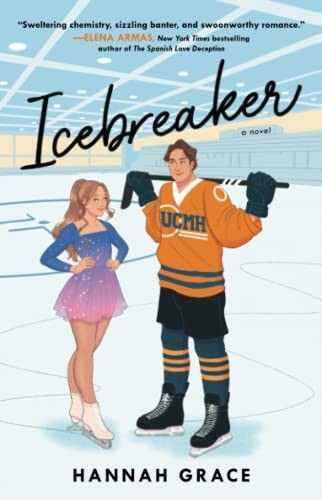
The thing that makes a partner feel irreplaceable is almost never the grand gesture. It is the accumulation of small ones — the person who notices what you need before you say it, who shows up at the right moment without being called, who takes your ambition seriously in the same breath as they take everything else about you seriously. That specific combination, when you find it in a story, is very hard to shake. Hannah Grace understood that when she wrote Icebreaker.
Anastasia Allen is a figure skater whose entire life is organized around a single goal, and she is not looking for a distraction. Nate Hawkins is a hockey player who shares her practice ice and should, by any reasonable account, be exactly that. Grace builds Icebreaker around the question of what happens when someone decides to be an asset to your life instead of a complication — when the person who is theoretically in your way turns out to be the person making everything easier. It is a different kind of romance than the push-pull most readers expect, and it is quietly devastating because of that difference.
What Grace understands about sports romance — and what distinguishes Icebreaker from the crowded field around it — is that the athlete’s relationship to her work is not an obstacle to be overcome by love. It is the thing love has to be compatible with or it is not the right love. Nate’s support for Anastasia is not despite her ambition. It is because of it. That shift in framing is why readers who found this book on BookTok stayed with it long after the algorithm moved on.
The ice rink setting does specific work in this novel. Figure skating and hockey occupy the same physical space but entirely different worlds within the sports hierarchy, and Grace uses that tension throughout — the way two people can be in exactly the same place and inhabiting completely different realities. The sharing of ice is both literal and symbolic, and the moments where those worlds overlap are where the romance lives. Grace’s attention to the specific texture of both sports makes the setting feel genuine rather than decorative.
Sports romance translates remarkably well to audio — there is a pacing and an energy to the athletic sequences that narration captures in a way that complements the quieter emotional moments, and the banter between the leads has a rhythm that works particularly well when spoken.
The grumpy-sunshine dynamic here — where one person brings warmth to someone who has been all edges for a long time — also runs through Elsie Silver’s Heartbreaker, which handles the cowboy-sport crossover and the redemption arc with the same emotional generosity. For readers drawn to the forced-proximity, shared-space tension specifically, Sandra Brown’s Hawk O’Toole’s Hostage offers a much earlier, more combustible version of two people who keep ending up in the same room until they stop pretending that is an accident.
Icebreaker works because it makes the case that the most romantic thing a person can do is pay attention — to what you need, to what you are working toward, to who you actually are when the performance stops. Some readers will recognize that feeling as something they have been waiting for a very long time to see described accurately.
Grace’s Maple Hills series rewards reading beyond this first entry. Hannah & Nate concludes their story, and subsequent books in the series follow other characters in the same sports-college world with the same warmth and the same understanding of what it means to love someone who is as serious about their work as you are about yours. The world Grace built accumulates with each addition, and readers who fall for Anastasia and Nate tend to want more of the community around them.
A note for readers new to sports romance specifically: the category has expanded significantly in the past decade, and the quality varies considerably. What distinguishes the better entries — and Icebreaker is among them — is the specificity of the sports knowledge and the refusal to treat the athletic identity as simply a backdrop for the romance. When writers understand that the sport shapes the person and the person brings that shaping to the relationship, the romance gains a texture it cannot achieve otherwise. Seek out books where the sport genuinely matters to who the characters are, and you will find the best of what the category has to offer.