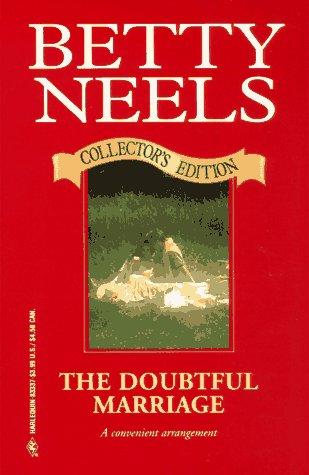
Not every love story arrives in dramatic gestures. Some of them accumulate in the space between two people who were not looking for anything — through small kindnesses and honest conversation and the gradual understanding that someone else’s presence has become something you did not know you were missing. Betty Neels built an entire career on that quieter mechanism, and The Doubtful Marriage is one of the finest examples of what she understood about how ordinary lives contain extraordinary feeling.
Matilda is practical and capable and quietly stubborn — the kind of woman who has organized her life so efficiently that there is no obvious gap in it, and who is therefore surprised to find that a marriage of convenience with Rauwerd, a Dutch doctor she has only just met, does not feel like the practical transaction it was supposed to be. Neels does not build to dramatic revelations. She builds to mornings over coffee and small moments of genuine attention and the slow accumulation of two people choosing, incrementally and without announcement, to be present for each other. It is a radical gentleness, and it works completely.
Neels wrote a world that is not like most romance worlds — no grand passion, no explosive conflict, no villain to overcome. Just two people in close proximity discovering that the arrangement they entered for practical reasons has become something else without either of them quite noticing when it happened. For readers who have grown fatigued by drama and intensity, Neels offers something genuinely different: the romance that happens in the register of ordinary life, which turns out to be plenty. More than plenty. The small moments in her books are not a consolation prize for the absence of spectacle. They are the point.
The marriage of convenience structure in this book is particularly well-chosen for Neels’s purposes. It gives both characters a legitimate reason to be in each other’s daily lives without requiring any declaration of feeling — the arrangement does the proximity work without the vulnerability of choice. What Neels then builds is the slow recognition that the practical arrangement has become something neither of them arranged for, arriving in the specific register of a woman who notices that she has started planning her meals around what he might enjoy, and a man who finds himself looking at his watch in the afternoons in a way he did not before she was there to come home to.
Neels’s quiet pacing is a surprisingly good fit for audio — a long bath, a slow afternoon, a walk that takes longer than planned. The unhurried rhythm of her storytelling becomes atmospheric rather than slow when you are hearing it, and the Dutch settings she uses (she married a Dutch doctor and knew the country well) have a particular quality in narration that rewards the immersive mode.
Neels wrote over 130 novels, all operating in roughly the same register — warm, practical, unshowy, deeply satisfying in their quiet way. Readers who find this world tend to call them “comfort reads” with a sincerity that is its own form of critical praise: these are books people return to when the world is too loud, when they need to be reminded that ordinary life, attentively rendered, contains everything that matters. The Doubtful Marriage is among her best, and the best place to begin for readers who have not yet discovered that a love story does not need to raise its voice to be heard.
Nothing dramatic happened. Everything changed anyway. That is the Neels promise, and she delivers it with a consistency that is its own form of excellence. The Doubtful Marriage is a perfect entry point into a world that speaks at a register most romance fiction has forgotten how to use.
A practical note for readers approaching Neels for the first time: her books are short by current romance standards, following the Harlequin format she worked in throughout her career. This brevity is appropriate to the emotional scale she is working at — the register is quiet, and a shorter length suits it better than the sprawl of a modern trade novel would. Do not bring expectations calibrated by longer contemporary romance, and you will find that what she delivers in 180-200 pages is as complete and as satisfying as anything twice the length. Compression, in the right hands, is a form of craft.