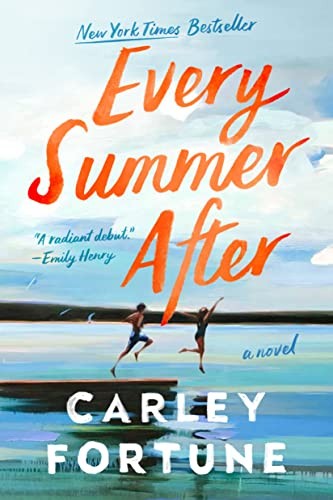
Summer romance has its own grammar in contemporary fiction — it runs on nostalgia and heat and the particular openness that comes from time that belongs to no one in particular. Carley Fortune’s Every Summer After understands that grammar and adds a layer underneath it: the weight of a summer romance that didn’t stay summer, that bled into autumn and winter and all the years after, and that left marks still visible a decade later.
The structure is a dual timeline — present day and the past summers that built the relationship between Percy and Sam. Fortune uses the dual timeline with unusual skill, parceling out the past with enough care that what destroyed things is visible to the reader before it is fully understood, and the present reconnection carries the full weight of that accumulated history. Percy arrives back in Barry’s Bay, a small cottage town in Ontario, for a family emergency that has nothing to do with Sam. He is still there. The summers are still there. Everything that happened is still there.
What Fortune captures with particular precision is the specific texture of a childhood friendship that becomes something more — the way it happens so gradually that neither person can identify the moment it changed, and the way that ambiguity becomes its own kind of problem. Percy and Sam’s dynamic across the summers is rendered with genuine warmth: the inside jokes, the shared rituals, the language that developed between just the two of them. This is what makes the loss land so hard. Fortune doesn’t shortcut the good part to get to the complication.
The present-day narrative is quieter and more complicated. Percy and Sam are adults now, with adult lives that have shaped them in ways their teenage selves couldn’t have anticipated. The reconnection isn’t an erasure of the intervening decade — it is a negotiation with it. Fortune is honest about what time does to people who were once essential to each other, and that honesty is what elevates the romance above simple nostalgia into something that asks more of the reader and gives back more in return.
This is a deeply satisfying audio experience — Fortune’s prose has a rhythm that suits listening, and the dual timeline, when narrated well, creates an emotional layering that the page doesn’t quite replicate. For readers who loved the temporal structure of People We Meet on Vacation and wanted something with more of the cottage-country, midsummer atmosphere, this is the book that was written for exactly that appetite.
The Canadian setting deserves a specific mention. Barry’s Bay and the lake-cottage world Fortune has built are specific and real in a way that is relatively rare in contemporary romance, which tends to default to American settings. The geography is not incidental — the rhythm of the cottagecore summer, the particular freedoms and confines of a small town where everyone knows everyone, the way the natural world becomes part of the emotional landscape — all of it is doing work in this book.
What Every Summer After understands is that the hardest love stories are not the ones where the people involved were wrong for each other. They are the ones where the people were right for each other and the timing, the circumstances, the particular failures of teenagers who didn’t know how to protect what they had — all of it conspired against them anyway. Fortune writes that version with enormous gentleness. The reader feels every summer lost and every one recovered.