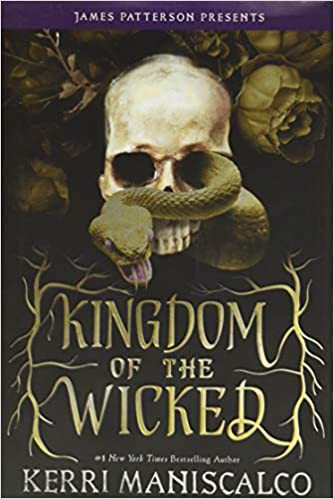
Sicily in the late 1800s, blood on the floor, and a girl furious enough to summon a demon. That is the opening of Kingdom of the Wicked by Kerri Maniscalco, and it delivers on that premise in the way that the best historical fantasy romance does — by building a world where the supernatural and the emotional are genuinely inseparable.
Emilia di Carlo is a Sicilian girl who grew up in a family that understands magic as something real and something dangerous, to be handled with respect and restraint. When her twin Vittoria is murdered in a ritual killing that suggests something far darker than a human crime, Emilia abandons restraint entirely. She summons Wrath, one of the seven Princes of Hell, and makes a deal: he helps her find her sister’s killer; she helps him with something he declines to fully explain. The asymmetry of that deal is one of the book’s pleasures — Emilia is smart enough to know she doesn’t have the whole picture and keeps trying to work out what she’s missing, while Wrath is consistent enough in his behavior to be trustworthy even when he won’t explain himself.
Maniscalco is a stylist. The prose in this book is lush without being purple, specific without being exhausting, and the historical texture of the Sicilian setting — the food, the dialect, the social hierarchies, the particular quality of Catholic guilt and its relationship to folk magic — gives the fantasy elements a weight they wouldn’t have in a more generic world. The demons in this universe are not abstractions. They are political entities with their own hierarchies and agendas, and Emilia is navigating them with the tools of a girl raised to cook and pray and know that some things should not be invited inside.
The romance with Wrath is slow and genuinely earned. He is not soft. He is not trying to be. What he is, consistently, is honest in a way that the human world around Emilia is not, and that honesty becomes its own form of intimacy. Readers who found themselves most drawn to the scenes in A Hunger Like No Other where the supernatural love interest’s difference from human men was the actual appeal will recognize what Maniscalco is doing here.
The audiobook is atmospheric in the way that historical settings benefit from narration — the Italian names and phrases, the texture of the period dialogue, all land differently when heard rather than read. It’s a particularly satisfying listen for anyone who loves the feeling of being fully transported to another time and place.
For readers who came to romantasy through From Blood and Ash and found themselves wanting something with more historical grounding and a love interest who operates from a position of genuine power rather than disguised danger, this is the natural next step. The mystery plot is strong enough to sustain the story on its own terms; the romance makes it something you’ll think about long after the last page.
What this book understands is that the best forbidden attraction stories are not about bad decisions. They are about the specific feeling of encountering someone whose world operates by entirely different rules than yours — someone for whom your lines aren’t lines at all — and discovering that the difference is, somehow, the most clarifying thing that has ever happened to you.