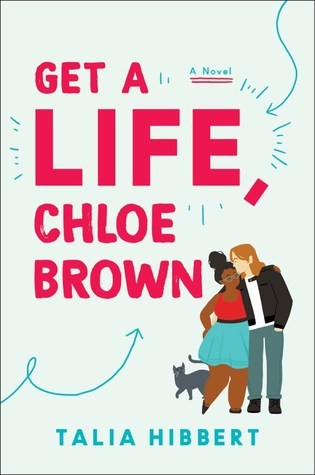
Almost dying clarifies things, and the thing it clarified for Chloe Brown was that she had been playing it very safe for a very long time. She made a list. It was not a dramatic list — no skydiving, no world travel, no grand gesture toward a life she had never wanted. Just things she had told herself she could not do, for reasons that had once felt valid and now felt like excuses. Talia Hibbert built Get a Life, Chloe Brown on that list and on the man who becomes her accidental accomplice in working through it.
Chloe has fibromyalgia, which means her body is unpredictable and her life has been organized around that unpredictability in ways that have made her world quite small. Redford “Red” Morgan is her building’s superintendent — tattooed, gruff, recently heartbroken, and visibly uninterested in making friends with the sharp-tongued woman on the third floor. Hibbert puts them together through the mechanics of the list, which requires Red’s specific skills and availability, and then builds the romance through the accumulation of those encounters. His hostility is not armor for its own sake — it has a recent cause, and as that cause becomes clear, his warmth underneath it becomes accessible in ways that feel earned rather than convenient.
What Hibbert does with Chloe that the genre rarely manages is render chronic illness as a lived reality without making it either inspirational or tragic. Chloe’s fibromyalgia shapes her day in concrete, specific ways — her energy budget, her relationship with spontaneity, the particular mathematics of deciding what is worth the cost. Red’s growing understanding of how she navigates her body becomes one of the quiet indicators of his feelings, because his adjustments are not dramatic. They are just attentive. He pays attention. That attentiveness is one of the most precisely romantic things Hibbert gives him to do.
Hibbert is one of three sisters who all write romance, and the Chloe Brown book opens a trilogy following the Brown sisters — Take a Hint, Dani Brown and Act Your Age, Eve Brown follow her siblings with the same warmth and the same quality of grumpy-but-actually-soft hero. Each book works as a standalone, and reading all three gives the reader the pleasure of a found-family dynamic extended across an interconnected world. The sisters are distinct enough to feel like real people rather than character types, and each hero is calibrated specifically to his heroine in ways that make the match feel inevitable.
For readers drawn to the chronic illness heroine rendered with specificity and dignity, The Kiss Quotient by Helen Hoang offers a different condition and a different dynamic but the same quality of inside-knowledge that makes the portrayal feel real rather than approximate. For the grumpy-sunshine dynamic with a similar warmth ratio, It Happened One Summer by Tessa Bailey runs the same engine in a small-town setting — sunshine heroine, resistant hero, the slow discovery that the resistance was never going to hold.
Red did not want to be her accomplice. He did not want to care about whether her list got finished. He did not want to understand, in specific detail, how she moved through a day that was harder than it looked. He ended up doing all of it anyway, incrementally and without announcement, in the way that actual care tends to work when it is genuine. Get a Life, Chloe Brown is a love story about that kind of care — specific, attentive, completely unromantic in its delivery and entirely romantic in its effect.
Hibbert’s voice is one of the sharpest in contemporary romance — dry, precise, genuinely funny in a way that does not undermine the emotional depth. The banter between Chloe and Red is among the best in the genre for that reason: it is weapons-grade wit deployed by two people who are both using it to avoid saying what they actually mean, and the gap between what they say and what they mean is where the entire love story lives.
One more note on what makes this book worth finding: it was published in 2020 and was one of the earlier contemporary romances to gain mainstream traction with a Black British heroine written by a Black British author. That representation matters beyond the obvious reasons — it shaped the specific texture of Chloe’s world, her family dynamics, her class position, and the way she navigates her relationships with a specificity that cannot be approximated from the outside. The book feels lived-in because it is, and that quality is part of what made it one of the most-recommended contemporary romances of its year.