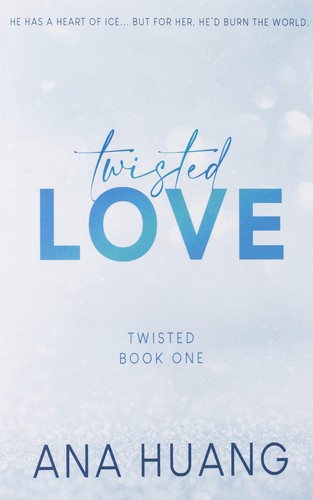
The most intoxicating version of this story is when the person coming undone is furious about it. When they have built an entire identity around not needing anyone, constructed every wall with care and precision, and then find themselves in the presence of someone who bypasses all of it without even trying. The crack in the armor is more seductive than anything deliberate could be — because it is involuntary, and they both know it. That is the engine of Twisted Love, and Ana Huang runs it at full throttle.
Alex Volkov is the cold, controlled, morally gray love interest done at full volume. He does not engage with people on emotional terms. He does not lose composure. Ava is his best friend’s sister — already off-limits, already a complication — and she is warm in a way that does not compute with his framework. Ana Huang builds their dynamic on that specific friction: his iron control versus her warmth that bypasses it entirely. He is guarded with her not because he dislikes her but because she makes him feel things he has no architecture for, and distance is the only defense he has left.
The best friend’s sister dynamic creates built-in forbidden energy before the romance even begins — the social and emotional stakes are already elevated, which means every step toward each other costs something real. The loyalty at risk is not abstract; it has a name and a history, and Alex is acutely aware of exactly what he is risking by allowing himself to feel what he feels. Readers connect with Twisted Love because Alex’s controlled exterior and what lives underneath it is a very specific fantasy: the man who only loses control for you, specifically, because of something in you that he cannot categorize or dismiss.
Huang also does something technically interesting with Alex’s characterization: the reader understands him more fully than he understands himself, because the narrative gives access to his internal state while he is still constructing the performance he presents to everyone else. You see the performance and the reality simultaneously — the control and the complete absence of it — and that gap is where the tension lives.
The internal monologue work in this book is especially effective in audio, where the gap between what Alex says and what he is actually thinking becomes almost unbearably clear. You hear the performance and the reality simultaneously in a way the page can suggest but the right voice performance can make genuinely visceral.
The Twisted series rewards continuation — Huang builds a world of morally complex characters whose stories deepen as you accumulate them, and each subsequent book casts the characters of the previous ones in a slightly different light. Twisted Games, which follows Ava’s brother Rhys, offers a bodyguard romance with similar forbidden energy and a hero whose control is even more rigidly maintained. Twisted Hate plays the enemies-to-lovers dynamic at its most volatile. If the emotional architecture of this first book works for you, the series will hold you for a long time.
When the most controlled person in any room loses control specifically because of you — not despite who you are, but because of it — that is not a small thing. That is the whole story. Twisted Love knows it, and it makes you feel every degree of the temperature change.
Ana Huang’s particular skill is building morally ambiguous heroes who are genuinely difficult to defend in the abstract and impossible not to root for in practice. Alex is not good. He does things in this book that are not forgivable on paper. And yet Huang renders his interiority with enough honesty that his choices feel human rather than monstrous — the choices of someone who has learned to operate in a world that rewarded the performance and never asked about the person underneath it. That is harder to write than it looks, and Huang does it well.
For readers who want to stay in the morally gray hero space after this book, Icebreaker by Hannah Grace offers a hockey romance with a similar dynamic — a controlled, guarded hero whose defenses prove no match for the right person — but with a lighter emotional register and more overt humor. The contrast is useful: Huang pushes the darkness further and holds it longer, while Grace keeps the warmth closer to the surface. Both approaches have their virtues, and both deliver the central pleasure of watching someone choose to stop pretending.