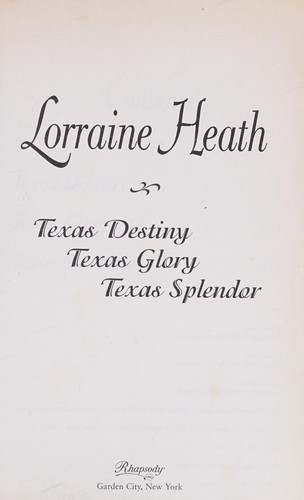
A marriage negotiated across a kitchen table, with terms and conditions and a handshake at the end — this is not the romance anyone grows up imagining. And yet something happens in the space between two people who entered an agreement for practical reasons and find themselves, gradually and without authorization, building something that the agreement did not account for. Lorraine Heath knew exactly what she was doing when she constructed Texas Glory around that space, and the result is one of the most quietly devastating marriage-of-convenience romances in Western historical fiction.
Cordelia McQueen needs a husband to escape a situation at home that is getting worse. Boyd Leigh needs a wife to meet the land grant conditions that will secure his ranch. Their arrangement is documented, witnessed, and entirely without sentiment. Heath places them in the Texas frontier in the 1870s, a setting that removes every social cushion and creates the specific intimacy of two people who have to depend on each other in practical terms before they have any emotional language for what is developing between them. Boyd learns to want before he learns to say it. Cordelia learns to feel safe before she learns to trust it. Heath slows both processes down to the pace of real feeling.
Boyd is a particular kind of romance hero that the Golden Era understood well and contemporary romance has partly lost: the man of few words whose actions are the primary text. He does not explain himself or declare himself. He simply does — consistently, specifically, in ways that accumulate meaning before either character has named what they are doing. When he finally does speak directly, it lands with the weight of everything that built toward it, because Heath has made the reader feel the full length of his silence. That restraint is a craft choice, and she executes it precisely.
The Texas frontier is more than setting in this book — it is a pressure system. The land requires constant work; the distances isolate; the conditions create emergencies that force Boyd and Cordelia into proximity and mutual dependence in ways that a drawing room courtship could never produce. Heath uses the physical reality of frontier life to do emotional work that more decorated settings cannot, and the result is a romance that feels genuinely earned by the world it inhabits rather than simply placed inside it.
Heath’s Texas trilogy — which includes Texas Destiny and Texas Splendor, following Boyd’s brothers — rewards reading in sequence. The world she built in this frontier setting accumulates texture with each book, and the family dynamics that the first book establishes deepen across the subsequent volumes. Starting with Boyd and Cordelia is correct; their story sets the emotional standard and the frontier context for everything that follows.
For readers who love the marriage-of-convenience structure and the slow build of genuine feeling from an arranged beginning, The Doubtful Marriage by Betty Neels offers a much quieter version of the same mechanism in a contemporary English setting — similar in its patience, completely different in its texture. The Wall of Winnipeg and Me by Mariana Zapata is the contemporary equivalent of the quietly certain hero — different era, same restraint, same payoff when the restraint finally ends.
They shook hands on it. They meant to keep it business. Neither of them planned for the specific way that sharing a life, even a practical life, starts to feel like something else entirely once you have done it long enough. Texas Glory is about the moment you realize the arrangement has become the thing you would not give up — and what it costs to say so out loud, for the first time, to the person who has been waiting to hear it longer than you knew.
Heath went on to write a substantial body of Victorian and Edwardian historical romance in addition to her Western work, and the quality of her historical research and her emotional precision is consistent across both settings. For readers who connect with her understanding of the slow-building romance and the stoic hero, her London-set Victorian titles offer the same patience and the same warmth in a more constrained social world — which creates its own kind of pressure and its own kind of payoff. She is one of the most undersung names in historical romance, and both her Western and Victorian catalogs deserve more readers than they currently have.