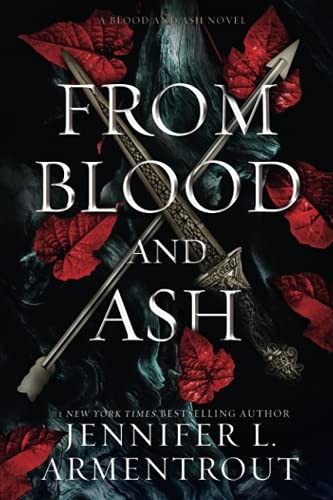
Wanting someone you are not allowed to want carries its own specific agony. The prohibition does not kill desire — it intensifies it. Every accidental brush of a hand becomes loaded with everything neither of you is saying. Every careful distance maintained is its own kind of declaration. And when the rules are written into the mythology of the world itself, when violation carries consequences beyond embarrassment or heartbreak, the desire becomes something else entirely: an act of defiance neither person can quite bring themselves to commit, and cannot quite stop themselves from moving toward.
Poppy has been isolated her whole life under the guise of protection. She is the Maiden — sacred, untouchable, kept apart from the world by rules she did not make and cannot question. Hawke is her guard. He is not supposed to feel what he feels. She has spent years pretending she does not feel it either. Armentrout builds the tension through proximity and restraint: two people in constant close contact, bound by rules that grow heavier the more they matter. When those rules finally break, they break completely.
This book works because the forbidden is not arbitrary — it is woven into the mythology of the world, which means violating it carries genuine stakes. Poppy has been denied so much that wanting something for herself feels radical. Hawke’s restraint makes every moment he slips through his own defenses devastating, because you have watched him hold that line for so long. Armentrout understands that the slow burn only earns its heat if the thing being burned matters — and here it does, deeply, in both directions.
What Armentrout also understands is how to build a world that earns its mythology. The world of From Blood and Ash is not simply a fantasy backdrop for a romance — the mythology, the religious structure, the political tensions between the Ascended and the people they govern — all of it creates a pressure that presses down on Poppy and Hawke from every direction. The romance gains weight from the world, and the world gains emotional meaning from the romance. It is a series that rewards readers who stay past the first book, because Armentrout uses the subsequent volumes to deepen everything the first one sets up.
The world-building and the emotional tension both benefit enormously from audio narration. The slow build of their dynamic — all that restrained wanting set inside a world with real mythological stakes — lands with particular force when you are inside it rather than observing from a distance. The narration handles both the action sequences and the quieter, more charged scenes between Poppy and Hawke with equal skill.
If the fantasy romance world is new territory, this series opens onto a wide landscape of titles where forbidden dynamics are deepened by the stakes of the world the characters inhabit. A Court of Thorns and Roses by Sarah J. Maas builds a similar tension between a human woman and a fae world that considers her expendable, with a forbidden element woven into the mythology itself. The Bridge Kingdom by Danielle L. Jensen takes the forbidden further into political territory — an arranged marriage between enemies, where every act of connection is also an act of potential betrayal. Both series share with Armentrout the understanding that a fantasy world earns its romance by making the cost of love legible within the rules of the world.
A practical note for readers approaching this series: the first book ends in a way that reframes much of what came before, and it is worth going in knowing that the story continues across multiple volumes. Armentrout is building something larger than a single romance — she is constructing a political and mythological world that deepens with each installment. Readers who fall into this series tend to fall completely, and the catalog waiting for them on the other side is substantial.
When everything you have ever been denied — freedom, choice, touch, genuine connection — comes down to one person who sees you as a person rather than a sacred object, that is not just romance. That is the story of being finally, fully seen. From Blood and Ash knows exactly what it is doing with that premise, and it does not let you go easily.