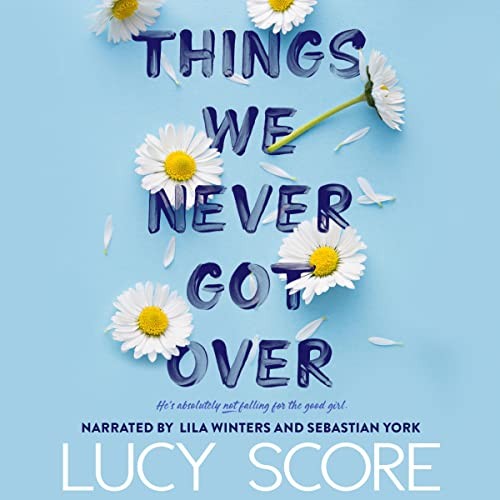
Ending up somewhere you did not plan to stay is its own kind of story. You were passing through. You had a reason, a timeline, a life that was waiting for you to get back to it. And then something happened — something small or something catastrophic — and the passing-through became a pause, and the pause became something you cannot quite bring yourself to end. Lucy Score wrote that specific situation with warmth and precision in Things We Never Got Over, and it became one of the biggest romance novels of 2022 for very good reason.
Naomi shows up in Knockemout, Virginia, to rescue her twin sister from a disastrous wedding — and finds the groom gone, the sister gone, and a small girl who has nobody else. Knox Morgan, who runs the town’s bar and wants absolutely nothing to do with Naomi or her chaos, becomes her reluctant neighbor in both the literal and emotional sense. Score builds their dynamic on resistance that is entirely unconvincing — he is gruff and certain and makes it very clear she is a complication he does not want, and he cannot stop showing up anyway. That contradiction is the engine of the book.
What Score understands about the grumpy-sunshine dynamic that lesser versions miss: the sunshine cannot be oblivious. Naomi sees Knox clearly — the specific shape of his guardedness, the reasons it exists, the effort he is putting into not wanting her. She is warm not because she does not notice difficulty but because she has decided warmth is worth it anyway. That clarity is what makes her interesting to him, and what makes the reader root for her even when his walls are at their highest. He is not immune to warmth in general. He is specifically, inconveniently not immune to hers.
The small girl Naomi stays for, Waylay, is one of the better child characters in contemporary romance — genuinely rendered rather than used as a plot device, with her own interiority and her own arc that runs alongside the romance without being consumed by it. Score gives the found-family element real emotional weight, and by the time the romance between Naomi and Knox is fully on the table, the reader has invested in all three of them equally. That breadth of investment is what makes the ending land with the force it does.
Score’s Knockemout series continues through Knox’s brothers, and the world she built in this first book accumulates warmth with each entry. The town itself functions as a character — opinionated, connected, exactly the kind of place that makes leaving harder than arriving. Readers who fall into this world tend to stay well past the first book.
The small-town accidental-life story that Score tells here has cousins across the genre. Archer’s Voice by Mia Sheridan runs a similar engine — a woman who drives until she cannot anymore, ending up in a small town and in the orbit of a man who is guarded for specific reasons. For readers who love the grumpy hero done right and want to stay in contemporary romance, Icebreaker by Hannah Grace offers a different setting with the same essential warmth — the person who is all edges around everyone else, and completely undone by one specific person. Both understand that the grumpy hero is only as good as the reason he stops pretending.
She did not mean to stay. The town did not mean to keep her. Knox did not mean to care. None of that meaning-to matters in the end. Things We Never Got Over is the story of an accidental life that turns out to be the right one — and it delivers that story with the warmth, humor, and genuine emotional intelligence that made Lucy Score one of the most widely read romance authors of her generation.
Score is building one of the most consistent catalogs in contemporary small-town romance, and Things We Never Got Over is both the best entry point into her work and one of the strongest examples of what she does. The humor is genuine, the pacing is propulsive, and the emotional payoff is earned through specific character choices rather than plot convenience. For readers who have been looking for the contemporary romance that makes them laugh and then feel genuinely moved within the same chapter — this is the one.