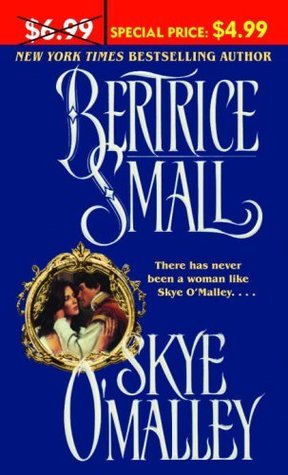
The epic historical romance carries a specific fantasy, distinct from anything the genre has produced since: the fantasy of a woman who moves through history on her own terms. Not despite the world she lives in, with all its rules about what women may own and choose and refuse — but through it, accumulating losses and loves and hard-won freedoms, never quite broken, never entirely safe, always herself. That fantasy requires a different kind of book than most romance provides. It requires a saga. Bertrice Small wrote one, and named it after the woman at its center.
Skye O’Malley is an Irish noblewoman born to the sea, and the sixteenth century is not a time or a world that accommodates a woman who commands her own ships and refuses to belong to any man who has not earned it. Small built the novel as an epic — multiple loves, multiple losses, empires encountered and navigated and survived, a life lived at full scale in a world that keeps trying to reduce her. The love stories inside it are genuine, but the real subject of the book is Skye’s indomitability, and the men who love her do so because they recognize in it something that cannot be possessed, only witnessed.
What Small understood about the reader who found this book — in the 1980s, when it was published, and in every decade since — is that she wanted a heroine with a history. Not a girl at the beginning of her story, but a woman who has already survived things and is still standing and is not done yet. The emotional register of Skye O’Malley is different from contemporary romance precisely because of that scale; the loves are harder won, the losses more real, the joy of the recurring love that endures more meaningful because of everything it has survived.
The historical research in this book is one of its underappreciated strengths. Small’s sixteenth century is not a costume — it is a world with real political dynamics, real geographic specificity, real constraints on women’s agency and real exceptions to those constraints for women with enough power and nerve to push at them. Skye’s navigation of the courts of England, Spain, and the Ottoman Empire is grounded in actual historical context in ways that make her adventures feel possible rather than merely adventurous. That groundedness is part of what allows the epic scale without the book tipping into fantasy.
Epic historical romance of this scope is one of the genuine pleasures of long-form audio. A novel like Skye O’Malley rewards the immersive experience that audio provides — the world, the history, the sweep of a life lived across decades all settle differently when you are living inside it through narration over many hours.
Readers drawn to the epic, world-sweeping historical romance and the heroine who defines herself against her circumstances will find a smaller-scale but deeply felt version of that in Kathleen Woodiwiss’s The Wolf and the Dove, which puts a similarly self-possessed heroine in medieval England and refuses to make her submission simple. For a Highland version of the strong woman navigating a world that keeps underestimating her, Julie Garwood’s The Bride offers a warmer, more intimate rendering of the same essential dynamic.
Skye O’Malley endures in the memory of every reader who found it because it offered something the genre was not yet reliably providing: a woman whose story was worthy of the full weight of history, who loved deeply and lost and loved again and remained, through all of it, entirely her own. That is still a fantasy worth having, and Small told it at the only scale that could contain it.
Small’s broader catalog rewards exploration for readers who fell into Skye’s world. The Skye O’Malley series continues across multiple volumes — the story does not end with the first book, and Skye’s life, as Small conceived it, extends considerably further. Beyond the series, Small wrote other epic historical romances with the same commitment to the long form and the same interest in women who accumulate history rather than simply being defined by a single love story. Readers who find the scale and ambition of this book appealing will find more of both in her catalog.
A note on the era of romance this book represents: Skye O’Malley is a product of the 1980s, and it carries the conventions and the freedom of that period in ways that will be visible to contemporary readers. The era’s approach to consent, to female agency, and to the relationship between heroines and the men around them is different from current genre conventions — sometimes more transgressive in positive ways, sometimes less so. Approaching it with that awareness, as a document of a specific moment in the history of the genre as well as a story, makes the experience richer and more honest.