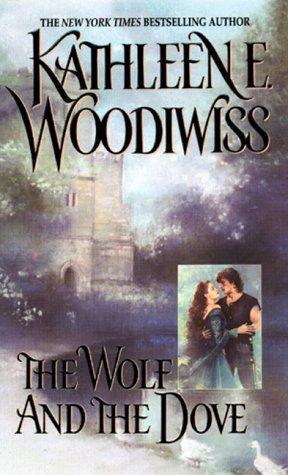
The man who takes everything and then cannot take his eyes off her. Who arrives with force and certainty and the complete confidence of someone who has never encountered a situation he could not command — and then finds himself in the specific, unfamiliar position of being the one who is slowly, quietly, undone. Not by force. Not by strategy. Simply by the sustained presence of someone who refuses to be erased by him. That is the architecture of The Wolf and the Dove, and Kathleen Woodiwiss built it with unusual care.
Aislinn and Wulfgar occupy one of the founding documents of the captive-captor dynamic in romance fiction. This is a medieval conquest story in which the power dynamic is never simple and never static — Wulfgar arrives as the authority, the occupier, the one who holds every structural advantage. And yet Woodiwiss builds the narrative around the way control, when it is real and not performed, is always quietly shifting. Aislinn does not fight him with weapons. She maintains her interior self — her dignity, her intelligence, her refusal to become what the situation might seem to require — and that maintenance is its own form of power that he has no strategy for.
Woodiwiss is among the architects of modern romance fiction as a genre. This book from 1974 helped establish the emotional mechanics that have driven the captive-captor dynamic for fifty years since, and reading it now, you can see the template clearly — the conqueror who thinks he is keeping her is always also being kept, and the moment he realizes this is the emotional center of the story. What Woodiwiss understood that her imitators often missed: the heroine cannot be broken. She can be placed in impossible situations. She cannot be reduced. Aislinn’s inward maintenance of herself is not passive resistance — it is the hardest thing in the book, and Woodiwiss makes the reader feel its difficulty and its dignity simultaneously.
The historical context here is significant. Woodiwiss was writing in a period when romance fiction was establishing its own conventions largely from scratch, without a preceding body of genre work to draw from. Readers who come to this book now will bring fifty years of subsequent genre context with them, which changes the reading experience in ways both limiting and enriching. The power dynamics that were genre-defining in 1974 are read very differently in 2026, and bringing that awareness to the book is appropriate rather than anachronistic. What remains consistent across all contexts is the quality of the interiority — the access Woodiwiss gives the reader to both characters’ experiences — which is the foundation of everything the genre built afterward.
The medieval atmosphere is immersive in audio — narrators who do this one well make the castle walls feel real, the landscape feel present, and the historical distance feel like texture rather than obstacle. The formality of the period language, handled well, adds to rather than detracting from the emotional accessibility of the characters.
Woodiwiss’s other work carries the same emotional DNA, and readers who respond to this historical captive dynamic will find a lineage of titles that followed in her wake. The Flame and the Flower, her first published novel, is the other essential Woodiwiss entry point — a different period, similar emotional architecture, the same quality of heroine who maintains herself through impossible circumstances. For readers who want to trace the template forward in time, Johanna Lindsey’s Golden Era work built directly on what Woodiwiss established, and contemporary readers can find the same dynamic updated in the work of writers like Kresley Cole and others who work in the paranormal space where the power differential can be made literal.
He thought he was keeping her. She was the one who stayed. Those are two different things, and the difference between them is the whole story. The Wolf and the Dove is one of the places where that story was first told at this scale, in this way, for an audience that recognized immediately what it was being given.
A note for readers new to Golden Era romance approaching this book: the experience is different from contemporary romance in pacing, in the directness of its emotional expression, and in some of the assumptions it makes about its readers. Woodiwiss assumed a reader who would meet her in the space between the lines, who would understand what was not said as clearly as what was. That kind of reading requires a slight recalibration if you come primarily from contemporary romance, but it is a recalibration worth making. The rewards are genuine and the experience is irreplaceable.