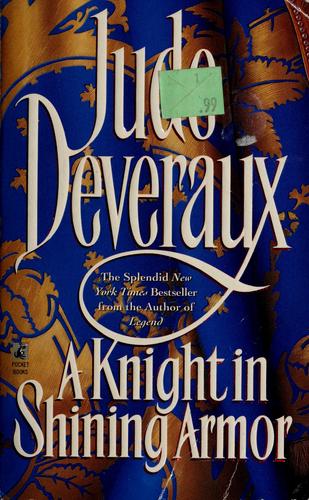
Wishing, in your lowest moment, for someone to simply appear — not to fix it, just to arrive — is a specific kind of fantasy. To be present in the middle of the wreckage, from somewhere outside the situation, unburdened by the context that made the wreckage possible. Someone who belongs to a different world entirely and therefore sees your problem from a completely different angle. That is the fantasy at the heart of time travel romance, and Jude Deveraux delivered it with particular clarity in A Knight in Shining Armor.
Dougless is at her absolute lowest point — sitting in an English churchyard, crying over a relationship that has publicly humiliated her, asking for nothing except for someone to help. Nicholas Stafford, a sixteenth-century earl, materializes from his tomb. He is bewildered by the modern world and entirely certain about Dougless in a way that has nothing to do with the context she came from. Deveraux understands that the appeal of time travel romance is not really about history — it is about rescue from outside the system that hurt you. Nicholas cannot have been part of what went wrong. That is the whole of his gift.
What Deveraux did with this book that made it stay in readers’ minds is write the emotional core of the wish with unusual honesty. Dougless does not need Nicholas to be perfect. She does not need him to be modern or easy or uncomplicated. She needs him to be outside her situation — and the specificity of that need, rendered with real care, is what lifts this beyond a gimmick. The time travel is a delivery mechanism for something emotionally true: sometimes what you need is the person the situation could not have contaminated, the one whose certainty about you was formed entirely independently of everything that made you doubt yourself.
The historical detail in this book is more thorough than most time travel romance, because Nicholas’s bewilderment at the modern world requires the sixteenth century to be real rather than decorative. Deveraux’s research is visible without being intrusive — Nicholas’s confusion at cars, at electricity, at the social position of women in the modern era is comic and disorienting and genuinely useful to the emotional arc, because it forces Dougless to see her own world clearly by explaining it to someone who has no framework for it. That device is smarter than it looks.
The shift between time periods has a dreamy, suspended quality in audio that the page cannot quite replicate — the disorientation of the transitions and the particular way Deveraux renders Nicholas encountering the modern world both benefit from narration. This is a title that rewards the audio experience specifically. A good narrator can hold the two temporal registers simultaneously in a way that deepens rather than confuses the emotional journey.
Deveraux’s other time travel romance, A Knight in Shining Armor stands as her most loved, but she returned to the subgenre in other titles that carry the same emotional architecture — the outsider hero, the modern woman who needs someone the system hasn’t reached. For readers who want to explore time travel romance beyond her work, Diana Gabaldon’s Outlander takes the mechanism in a considerably more epic direction, and Susanna Kearsley’s work offers a more literary, deeply researched version of the same mechanism with different emotional emphases. All of them trace something in common: the conviction that the right person can arrive from anywhere, including somewhere time shouldn’t allow.
He was not supposed to be possible. That was never a flaw in the premise — it was the whole point. The impossible arrival, at the exact moment of impossibility. That is the fantasy A Knight in Shining Armor delivers, and it has never gone out of print for a reason.
A note for readers who might assume time travel romance is a niche subgenre: the best entries in this category — and this book is among the best — operate on the same emotional principles as every other great romance. The mechanism is fantastical, but what the mechanism serves is entirely human: the need to be seen clearly, the need for rescue from outside the system, the need for a love that arrives without agenda. Those needs are not niche. They are universal, and that universality is why time travel romance has held its readership for decades.