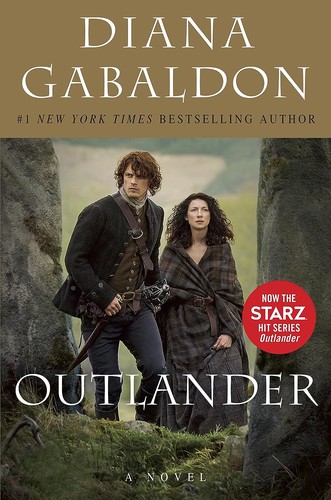
Inside Outlander there is a love story, and then there is the feeling the love story produces — which is something rarer and harder to name. It is the feeling of having been found by exactly the right person at exactly the wrong time, in the wrong century, under circumstances that should make the whole thing impossible, and discovering that none of it matters because some connections have a logic that history cannot interrupt. Diana Gabaldon knew what she was building, and she gave it the length and weight it required.
Claire Randall is not looking for Jamie Fraser. She is not looking for the eighteenth century. She falls through a standing stone in the Scottish Highlands and into a world that has no use for a woman who knows things she should not know, speaks with an accent no one recognizes, and belongs to a time that has not happened yet. Gabaldon builds the romance in the space between Claire’s disorientation and Jamie’s certainty — he knows what he is feeling before she does, which is one of the most quietly devastating moves in the book.
What Gabaldon does that other authors rarely attempt is scale. This is not a romance set against a backdrop of history — history is a character, and it has opinions about what Claire and Jamie are doing. The Jacobite rising is not atmosphere. It is a force that is constantly trying to separate them, and every reconciliation, every reunion, every page where they find their way back to each other carries the weight of everything the world has thrown at them to keep them apart. That accumulated weight is why Jamie Fraser became the standard against which romance heroes are measured for a generation of readers.
The series that follows the first book is one of the longest in the genre — nine main novels, multiple novellas, more than eight thousand pages of accumulated story. Readers who fall into this world tend to fall completely, and the investment is significant. What Gabaldon delivers in return is a love story that grows more complex and more earned with every obstacle, and a world so fully realized that readers often report feeling the loss of it when they reach the end. Going in knowing the scale of the commitment is useful. So is knowing that the investment is worth it.
If there is a series that was made for audio, it is this one. The Scots dialect, the sweep of the historical world, the length of the story — all of it settles into something different when it is read aloud. The Davina Porter narration is widely considered one of the great audiobook performances in the genre, and it is the definitive way to experience this world.
The emotional signature of Outlander — a heroine navigating a world that wants to break her, held together by a love that refuses to let go — echoes in Kathleen Woodiwiss’s The Wolf and the Dove, which builds a similar dynamic in a medieval setting with the same willingness to put its characters through genuine hardship. Readers who love the time-travel element specifically might find a quieter, more intimate version of that ache in Jude Deveraux’s A Knight in Shining Armor, where the wrong-century problem is handled with a different kind of heartbreak.
Outlander endures because it understands something true about the readers it found: that the fantasy is not really about time travel. It is about being known completely, across every obstacle the world can construct, by someone who chose you and kept choosing you. That fantasy does not age, and this series has not aged around it.
A note for readers who are uncertain whether to commit to a nine-book series: the first book of Outlander functions as a complete story within the larger arc, with a resolution that is satisfying on its own terms. Reading it and stopping is a legitimate choice. The readers who continue — and most do — do so because the first book creates a world they are not finished inhabiting and characters they are not ready to leave. That is Gabaldon’s particular achievement: not just writing a good book, but building a world readers want to live in for as long as she is willing to let them.