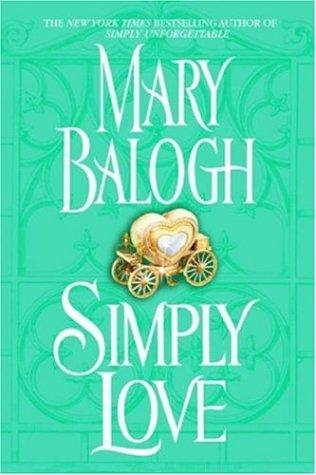
A particular kind of hope carries forward in people who have decided they are finished with it — not dead, exactly, but filed away. Decided against. The person who tells themselves: I tried that, and I know what it costs, and I am done now. And what happens when hope declines to stay filed. When it reasserts itself not dramatically but slowly, in spite of every rational reason it should not, through the sustained presence of someone who approaches carefully and does not rush and understands that there is a difference between patience and pressure. Mary Balogh wrote that slow reassertion with more precision than almost anyone in the historical romance genre.
Anne in Simply Love is a widow — not the kind the genre sometimes uses as narrative convenience, but a woman who has genuinely organized her life around the reality of her situation and found it workable. She is not waiting to be rescued. Sydnam has his own damage, visible and otherwise, and he is equally not seeking anything. Balogh brings them together in the unhurried way of her best work — through proximity that creates opportunity, through conversation that builds carefully rather than erupting dramatically, through the specific tenderness of two people who know the cost of things and approach each other accordingly.
Balogh writes emotional damage with more precision than almost anyone working in historical romance. The tenderness in Simply Love is earned in the particular way that things earned through patience feel different from things delivered by plot. Neither Anne nor Sydnam is performing health they do not have. Their carefulness with each other is itself a form of intimacy — the communication of two people who have both been in situations where carefulness would have helped and did not come. That carefulness is the love story, not just the context for it. Balogh understands this the way few writers do, and she trusts the reader to feel the weight of it without having it explained.
Sydnam’s particular damage — his physical difference from most romance heroes — is handled by Balogh with a directness that refuses both sentimentality and drama. He is not tragic. He is a man who has made a life with what he has, who has found work and purpose and some measure of peace, who is surprised to find that peace can contain something more. The specificity of his experience is rendered with such care that readers who encounter him tend to find him one of the most memorable heroes in the genre, precisely because Balogh refused to make his situation either an obstacle to be overcome or a wound to be healed by love.
Balogh’s measured prose translates beautifully to audio — the restraint in her writing becomes texture when heard, and the internal lives of her characters feel particularly present in narration. This is one of those titles that reveals more depth on second experience than on first, and audio makes the second experience accessible even if you have already read it in print.
The Simply quartet — Simply Unforgettable, Simply Love, Simply Magic, Simply Perfect — rewards reading in full, and the four books build a community of characters whose stories are enriched by the shared context. Beyond this quartet, Balogh’s Slightly series and her later Survivors’ Club series carry the same emotional precision and the same care for damaged heroes whose healing is never easy or fast. The Survivors’ Club in particular offers some of her most ambitious work — heroes with wartime damage, rendered with the same refusal to make recovery convenient that makes Simply Love what it is.
They were both so careful. That carefulness, which started as self-protection, became something else entirely — a shared vocabulary, a mutual recognition, a form of love that understood exactly what it was asking of both of them. Simply Love is quiet and precise and stays with you long after you have finished it, the way the quiet things always do.
One more note on Balogh’s craft, which deserves naming directly: she is one of the few historical romance writers who writes the interior of grief with genuine fidelity. Anne’s widowhood is not a plot device that exists to make her available for the romance. It is a real condition with real texture — the specific ways it shapes how she moves through the world, what she hopes for, what she is afraid of. That fidelity to what loss actually does to a person is what makes the hope that eventually reasserts itself feel earned rather than arbitrary. Balogh does not skip the grief to get to the romance. She understands that you have to earn the romance by telling the truth about what came before it.