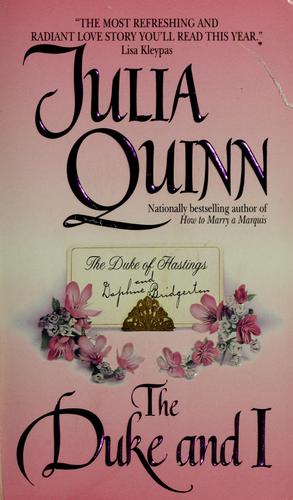
Performing love with someone you might actually love carries a particular danger. You can play at tenderness for an audience — manufacture the looks, the small touches, the way you lean slightly toward each other in conversation. What you cannot manufacture is the moment you realize you have stopped manufacturing. And by then it is far too late to pretend otherwise, even to yourself. Julia Quinn understood exactly what she was doing when she built The Duke and I on that mechanism, and she ran it to its logical, devastating conclusion.
Daphne Bridgerton needs a false suitor to quiet her mother’s relentless matchmaking. Simon Basset needs a fake fiancée to keep the marriage market at bay. Their arrangement is perfectly transactional. Neither of them plans for what spending every evening performing affection actually does to two people who are already, underneath all of it, drawn to each other. Quinn does something smart here: she gives both characters personal wounds that make the pretense particularly costly. Simon’s reasons for the ruse are bound up in his history with his father and a vow he made that he cannot easily unmake. Daphne’s desire for real love is sincere and specific. The pretense does not protect either of them the way it was supposed to, and the longer they maintain it, the more it costs.
Quinn’s Regency world is warm and witty, and the Bridgerton family itself functions as a character — their presence gives the story weight and context that makes the romance feel like it exists inside a life rather than instead of one. The siblings are distinct and memorable in a way that makes picking a favorite a genuine debate. But what makes this first book hold up is the specificity of Simon’s wound. He is not damaged in a generic way. His damage has a shape, and it matters to the plot in real terms, and the resolution costs him something genuine. That is what separates a good romance from a great one: whether the emotional stakes are structural or decorative.
The fake courtship dynamic is one of Quinn’s great strengths as a writer, and this book is its finest expression in her catalog. The social setting of Regency London adds pressure to the performance — every ball, every public appearance is also an audience to maintain, which means Daphne and Simon are never not performing for someone, and the gap between the performance and what they actually feel keeps narrowing in ways neither of them authorized.
The Bridgerton series has become iconic in audio — the performances carry a drawing-room warmth that matches Quinn’s voice precisely, and the banter between Daphne and Simon is particularly sharp when heard. There is a reason this series found a new generation of readers through audio long before any adaptation arrived, and the audio versions remain the best way to experience the full tonal range Quinn brings to the Bridgerton world.
The series rewards reading across the full family — eight siblings, eight books, an overlapping world that deepens with each entry. An Offer from a Gentleman (Book 3, Sophie and Benedict) is frequently named as a reader favorite for its Cinderella framework. Romancing Mister Bridgerton (Book 4, Penelope and Colin) is considered by many the emotional peak of the series, delivering a payoff built across the preceding three books. Starting at the beginning, with Daphne and Simon, is the right choice — the family context enriches everything that follows.
Quinn understood something about what readers want from a love story — not just the happy ending, but the journey of two people choosing each other honestly in a world that gave them every reason not to. The Duke and I is where that journey begins, and it has not dated a day.
A practical note on reading order: the Bridgerton series is best read in sequence, but Quinn designed each book to function as a standalone as well. Reading them in order earns the reader considerably more — recurring characters develop, secondary storylines resolve, and the family as a whole becomes richer and more three-dimensional with each addition. But if The Duke and I is your entry point, it will tell you everything you need to know about this world. It always has.