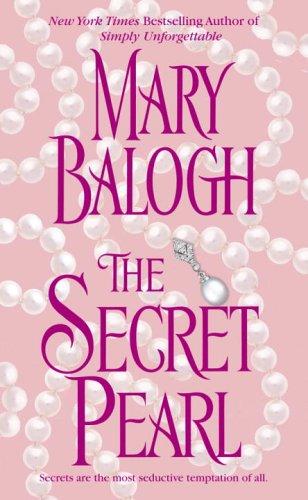
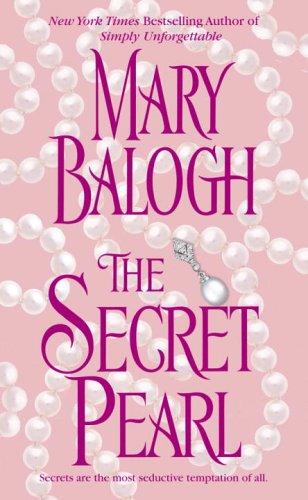
Invisibility as a survival skill — not the invisibility of absence but the invisibility of presence — is something women in constrained circumstances learn with precision. Being in the room, fully present, and still not registering on anyone’s attention. Lady’s companions understand this. Governesses understand this. Women who have learned to make themselves useful and unobtrusive in other people’s houses understand it with a precision that makes the alternative feel almost dangerous in its unexpectedness. Mary Balogh built The Secret Pearl on that alternative, and she handled it with the care it required.
Fleur has learned invisibility as a survival skill. Her concealment is not coyness but necessity — she has reasons for being hidden that the reader comes to understand gradually, and Balogh handles them with the care they require. Adam is the one man at the gathering who keeps finding her in the corners — not to flirt, not with any strategic purpose, but simply because she is, when he pays attention, the most interesting person in the room. His persistence in finding her is the romantic gesture of the book, not any grand declaration. Just: I keep looking for you. I keep finding you worth finding. That simplicity is the whole of it, and Balogh makes it enough.
Balogh writes the inner life of overlooked women better than almost anyone working in historical romance. Fleur’s guardedness is not a character flaw to be overcome — it is completely understandable, completely earned, and completely heartbreaking for a reader who understands what it costs to maintain it. The love story works because Adam’s interest does not require her to shed the guardedness before he extends it. He is interested in the person behind the invisibility without demanding she perform without it. That sequence — interest before disclosure, care before trust — is precisely correct, and Balogh knows it.
The historical setting does specific work in this novel. A woman in Fleur’s situation, in this period, has almost no structural options — her choices are severely constrained by the world she inhabits, and Balogh does not pretend otherwise. What Fleur has is her intelligence and her character, both of which she has maintained through circumstances that would have diminished a less resilient person. Adam sees those qualities before he understands her situation, and the sequence of that seeing is what makes the eventual disclosure matter as much as it does.
The interiority of Balogh’s heroines is especially vivid in audio — you live inside their heads in a way that the page sometimes only approximates. Fleur’s inner life is particularly rich, and the gap between what she lets the world see and what she actually is registers with full force when narrated. The restraint in Balogh’s prose becomes something almost musical when spoken aloud.
Balogh’s hidden identity and overlooked heroine titles form a consistent thread through her work. Slightly Sinful explores a similar question of concealed identity from a different angle, while the Survivors’ Club series examines characters who have had to rebuild their sense of self after circumstances that stripped it away. Both reward readers who responded to what The Secret Pearl is doing. Outside Balogh’s catalog, Dreaming of You by Lisa Kleypas is the natural companion read — a different overlooked woman, seen by a different kind of man, delivering the same essential emotional experience with Kleypas’s particular warmth.
She had learned to disappear. She was very good at it. And then someone made it impossible — not by demanding she stop, not by forcing visibility on her, but simply by being someone who kept looking in the corners. Who kept finding her worth the trouble of looking. The Secret Pearl understands exactly what that means, and handles it with all the precision it deserves.
A note on reading Balogh in sequence: The Secret Pearl is a standalone and works entirely on its own terms. But Balogh’s body of work has an accumulated quality that rewards broad reading — her understanding of overlooked women, damaged heroes, and the specific emotional cost of constrained lives deepens across books in ways that make each individual novel richer in context. Starting anywhere in her catalog and following the thread is a reliable approach. Starting here is as good as anywhere, and for readers drawn to the particular premise of this book, a better starting point than most.