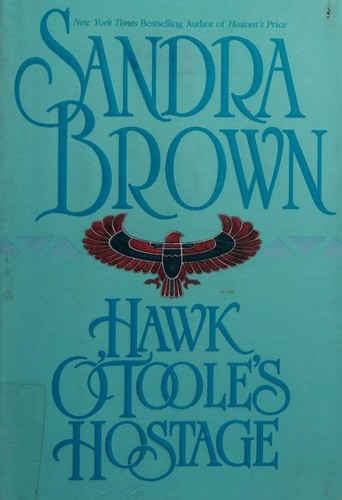
The strange intimacy of being trapped somewhere with someone — and realizing, quietly and then less quietly, that you are not as afraid of them as you expected to be — is an emotional situation that romance has understood for a long time. The circumstances that remove every social exit and force two people into the kind of proximity that normally requires months of deliberate relationship-building are a useful fiction. They are also, when handled well, a delivery mechanism for something genuinely true about how people come to know each other. Sandra Brown knew exactly what she was doing when she wrote Hawk O’Toole’s Hostage.
Miranda did not plan to find herself in Hawk O’Toole’s custody. He has his reasons, none of them personal, none of them her fault. Brown sets the forced confinement in motion with the logic of necessity — these are people thrown together by circumstances neither of them chose — and then watches what the proximity produces. The hostility dissolves not in a single dramatic scene but gradually, through the accumulation of moments where each of them chooses, slightly, to be human rather than adversarial. Brown stripped away every social escape route, and when there is nowhere to go, the emotional truth eventually has nowhere to hide either.
Brown understood that romantic suspense and forced proximity share structural DNA: external circumstances as the context that strips away the performances people normally maintain. Miranda can see who Hawk actually is because the situation has removed everything she would normally use to maintain a comfortable distance. He can see her for the same reason. The confined space is not a gimmick — it is an accelerant for exactly the kind of knowing that normally takes much longer to accumulate. What Brown built in this book is a love story that could only happen under these conditions, and that specificity is what makes it work.
Hawk himself is worth noting as a character. He is not simply a captor holding someone for leverage — he has history, community, a cause that is larger than the immediate situation, and people who depend on him. Brown gives him enough complexity that the reader can understand his choices without being asked to approve them, and that understanding is what allows the romance to function. A hero who is simply a kidnapper with good hair is not a romance hero. A man in an impossible situation making compromised choices for reasons the reader can follow — that is something the genre knows how to work with.
The confined tension of this one is amplified in audio — a good narrator makes the small space feel present, the walls close, the proximity inescapable. The emotional shifts land differently when you cannot see them coming, when you are as confined to the forward motion of the story as the characters are to their physical situation. This is one where the audio format enhances the central effect of the book.
Brown’s broader catalog rewards exploration — she built a long career in romantic suspense that consistently understands the intersection of danger and intimacy. Breath of Scandal and Mirror Image are frequently cited as her strongest titles in that intersection. For readers who want the forced proximity engine in a contemporary setting without the suspense element, Christina Lauren’s The Unhoneymooners runs the same spatial logic in a much lighter register — same mechanism, entirely different emotional temperature.
She stopped being his hostage long before he let her go. That is the thing about forced proximity done right — the structure that begins as coercion becomes something else entirely, and neither of them is quite sure when the transition happened. Hawk O’Toole’s Hostage knows exactly when it happened, and it makes you feel the full distance between those two things.
A note on this book’s place in the larger landscape of forced proximity romance: Hawk O’Toole’s Hostage was published in 1988, at a moment when the subgenre was still finding its conventions. Brown’s instinct — to use the confinement as character revelation rather than simple plot engine — was already sophisticated at this early date, and the book holds up partly because that instinct does not date. The specific circumstances feel period-appropriate, but the emotional work the circumstances are doing is as current as any contemporary forced proximity romance written today.