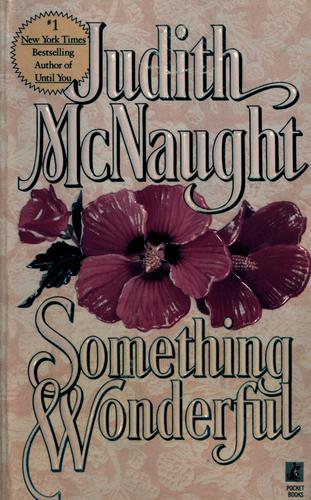
The specific torture of wanting someone you have already decided you cannot have — not forbidden by anyone else, but forbidden by your own code, your own loyalty, your own sense of what you owe to the person who trusted you with someone they loved — is a restraint that costs more than prohibition from outside. You are the one holding the line. And holding it, over time, in close proximity, takes a toll that eventually becomes unsustainable. Judith McNaught understood that toll better than most, and she built Something Wonderful on the full weight of it.
Jordan and Alexandra have one of McNaught’s more layered forbidden setups: she is his best friend’s sister — but the friendship itself is the bond being tested, which makes the stakes double-sided. Jordan has spent years being careful with her because the carefulness is what loyalty requires. Alexandra has spent years in the particular misery of loving someone who is being careful. McNaught builds the tension through restraint — the longing is almost unbearable precisely because he keeps choosing, actively and deliberately, not to act on it. And she knows it. That mutual knowledge, unspoken and maintained, is where the story lives, and where the reader spends most of the book.
McNaught’s strength is the long game. She does not rush the emotional timeline, which means when the restraint finally gives way, it gives way under the weight of everything that accumulated while it held. The payoff in her books requires patience — readers who have not encountered her pacing before should know that it is deliberate, and that it is what the payoff depends on. The building is the point, not just the arrival. If you try to rush a McNaught novel, you are reading it wrong.
Alexandra deserves particular notice as a character. She is young but not naive — she understands exactly what Jordan is doing and why, and she has enough self-knowledge to understand what it costs her to wait for a man who has decided not to want her. That self-knowledge makes her a more interesting heroine than the genre standard, because she is not fooled and she is not in denial. She is simply in love and aware that love does not always arrive on the terms you would choose for it. McNaught treats that clarity as a form of dignity, not a flaw, and the book is better for it.
The slow burn of McNaught’s pacing is exquisite in audio — do not rush this one. The restraint that the text builds requires time to accumulate, and the audio format enforces a forward momentum that serves the book’s architecture. This is a long session listen, and it rewards that investment entirely.
McNaught’s other Regency titles — A Kingdom of Dreams, Almost Heaven, Whitney, My Love — carry the same emotional DNA and reward exploration by readers who respond to her particular gift. Almost Heaven in particular explores a similar forbidden dynamic through the lens of class and reputation, with a heroine whose stubbornness matches Alexandra’s and a hero whose restraint is equally load-bearing. All of them understand that the restraint is not the obstacle to the love story — it is the love story, until it isn’t.
He protected her from himself for years. It was never going to hold — not because he was weak, but because some things cannot be maintained indefinitely in the presence of the person they are protecting against. The line he was not supposed to cross was always going to break him. That was the only possible ending, and Something Wonderful earns every step toward it.
One note on the emotional arc of this book: McNaught is not writing a comfortable love story. She is writing one that costs the heroine something real — patience, pride, the years she spent waiting for a man who had chosen not to want her. The resolution is earned, but it does not undo the cost, and the book does not pretend it does. That honesty is part of what makes McNaught’s resolutions feel genuine rather than convenient. The happiness at the end is hard-won, specific, and entirely deserved. That is the only kind worth writing about.