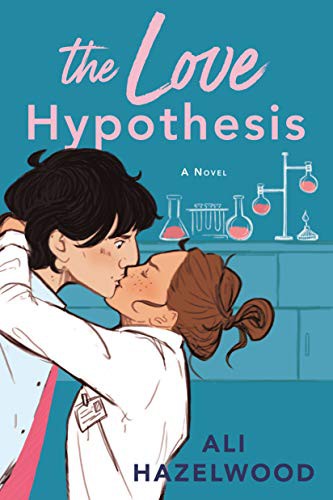
A very specific kind of person builds elaborate systems for managing the world — not because the world is frightening, exactly, but because the distance between what you feel and what you know how to say is large enough that structure helps. A hypothesis you can test. A fake relationship with clearly defined parameters. An agreement that has an end date, which makes it safe, which means you can let yourself feel things you would not feel otherwise. Ali Hazelwood built The Love Hypothesis around that logic, and around the blind spot it creates.
Olive Smith proposes a fake relationship to a notoriously difficult professor to solve a problem she can manage. Hazelwood builds the book on the gap between Olive’s formidable scientific mind and her catastrophic blind spot about what is actually happening between her and Adam Carlsen. He knows. He has known for a while. Watching a man who is genuinely intimidating to everyone else in the room become patient and careful and quietly devoted around one specific woman is its own kind of romance, separate from any plot mechanics.
What Hazelwood does well is render the inner life of a woman who has learned to be self-sufficient as a form of protection, and then show what it looks like when someone decides to make that protection unnecessary. Adam does not push. He does not explain himself. He simply keeps showing up, in ways that are small and consistent and unmistakable once you learn to read them. The moment Olive starts reading them is the emotional center of the book, and it is worth everything that comes before it.
The academic setting is doing real work in this book, not just providing an attractive backdrop. The specific pressures of graduate research — the funding instability, the advisor relationships, the competition that masquerades as collegiality, the way your entire future can pivot on one person’s opinion of your work — create a context in which Olive’s desire to manage everything makes complete sense. Carlsen’s position in that hierarchy is not incidental to the dynamic; his willingness to use what power he has in her direction is one of the clearest signals in the book, and Hazelwood times the reader’s understanding of it carefully.
The campus setting and the propulsive dialogue make this one genuinely fun on audio — the comedic timing in the awkward early scenes lands differently when narrated, and the slow shift from flustered to certain is a pleasure to hear rather than read.
The grumpy-professor-who-is-only-soft-for-her dynamic here has a contemporary sibling in Mariana Zapata’s The Wall of Winnipeg and Me, which takes the same emotionally guarded man and the same slowly dissolving distance and stretches the ache out to a remarkable length. For readers who love the fake-dating mechanics specifically, Julia Quinn’s The Duke and I does something structurally similar with a Regency setting and a heroine who is also considerably smarter than the situation she finds herself in.
The Love Hypothesis found its audience because it understood something about a certain kind of reader: the one who has spent a lot of energy being competent and not nearly enough energy being seen. Olive getting both — the career and the man who thinks she is extraordinary — is not just satisfying. For a lot of readers, it felt like permission.
Hazelwood’s subsequent novels — Love on the Brain and Not in Love — operate in a similar register: STEM heroines, emotionally unavailable heroes who turn out to be exclusively unavailable to everyone except the right person, slow-burn fake or accidental relationship dynamics that give the protagonists permission to feel what they are already feeling. Readers who respond to the combination of academic specificity and romantic warmth in The Love Hypothesis will find both in her subsequent work. The formula is consistent, and in the right hands, consistency is a virtue.
One more note worth making: the BookTok community was the primary driver of this book’s success, and that success has been occasionally met with skepticism from longtime romance readers who distrust viral phenomena. The skepticism is worth setting aside here. The book earned its readership by doing what it claims to do — delivering a specific, warm, emotionally satisfying love story with a heroine whose particular way of moving through the world will feel familiar and validating to a significant portion of readers. That is not a small achievement, regardless of how the discovery happened.