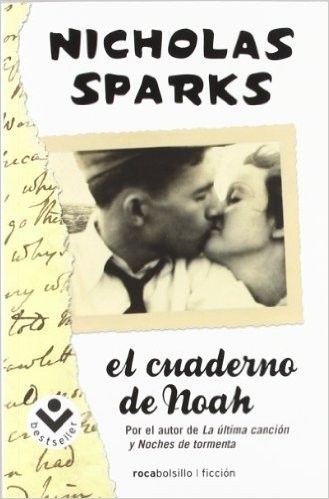
A kind of love does not know how to be less than what it is. It does not recalibrate when the circumstances change, does not negotiate with time or distance or the reasonable expectations of the world. It simply persists, in the same form, at the same scale, for as long as the person carrying it is alive. That kind of love is frightening and beautiful in equal measure, and it is very rare to find a book that takes it seriously without making it sentimental. Nicholas Sparks took it seriously in The Notebook, and the book has not let go of its readers in thirty years.
Noah Calhoun writes Allie Nelson three hundred and sixty-five letters over the course of a year. She never receives them. Her mother intercepts them, because Allie’s family has decided that Noah — local, working-class, without prospects — is not what Allie’s future should look like. Sparks builds the novel on that specific kind of loss: the love that was real and was taken away not by its own failure but by someone else’s decision that it was not worth having. The second-chance story that follows is quiet and patient and completely uninterested in making anything easy.
What Sparks understood, and what made The Notebook reach readers who do not normally read romance, is that the love story is nested inside a larger question about memory and devotion — about what it means to love someone so completely that the love does not require the other person to remember it. The framing of the novel is not incidental. It is the reason the story means what it means, and it hits differently depending on where you are in your own life when you encounter it. A twenty-year-old reading it and a sixty-year-old reading it are having genuinely different experiences of the same book.
The class difference between Noah and Allie is the load-bearing element that most discussions of the book underemphasize. Her mother’s intervention is not arbitrary — it is the expression of a real social dynamic, a real set of calculations about what a daughter’s future should look like and whose input that future is supposed to reflect. The love story is beautiful. The reason it was interrupted is painfully ordinary, and Sparks is honest about that ordinariness. The letters Noah writes are love letters and also evidence of how little the outside world cares about what the people inside it feel.
This is one of those rare cases where the audio and the film adaptation each did something distinct with the source material — readers who loved the movie and have never read the book will find a different emotional experience in the novel, one that is more interior and more patient, and worth hearing in its own right.
The second-chance structure here — love that survives separation and returns changed but intact — also runs through Mary Balogh’s Simply Love, which handles reunion romance with a similar emotional generosity in a Regency setting. For readers drawn to the devotion-across-time quality specifically, LaVyrle Spencer’s Vows offers a historical American version of that same steadfast love that endures everything the world throws at it.
The Notebook stays because it tells the truth about something most love stories are afraid to say: that real devotion is not dramatic. It is daily. It is the letters you write even when you do not know if they are received. It is the story you read aloud to someone who cannot remember why it matters, because you remember, and that is enough.
A note on Sparks’s place in the romance landscape: he is a writer who occupies a peculiar position in the category — widely read, frequently adapted, often approached with skepticism by romance readers who associate him with a particular brand of cinematic emotion. The skepticism is not entirely without basis, but it misses what the best of his work actually does. The Notebook is not a romance in the generic sense; it is closer to a meditation on devotion that happens to be structured as a love story. That distinction matters to how it should be read and what it offers.
For readers who want to explore more of Sparks’s work after this entry point: A Walk to Remember operates in a similar emotional register and is frequently cited alongside The Notebook as his best work. Message in a Bottle explores a different kind of devotion — love for someone who is gone, and what that devotion does to a person’s capacity to love someone new. All three of them are asking the same question from different angles: what are the obligations of love, and what does it cost to honor them when the cost is everything?