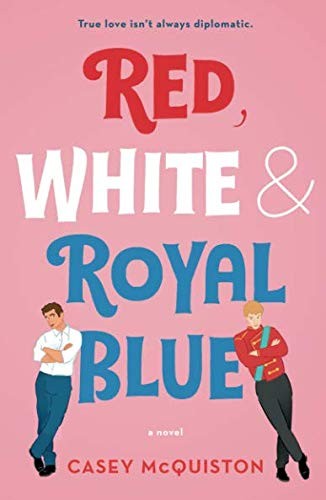
A very particular joy lives in a love story that builds a private world — the inside jokes, the references no one else would understand, the letters that are too honest, the way a relationship develops its own language before either person has admitted what it is. The world outside can be as large and as loud as it wants. In here, it is just the two of you, and it is funny and real and impossible to explain to anyone who was not there for it. Casey McQuiston understood that dynamic exactly when she wrote Red, White & Royal Blue.
Alex Claremont-Diaz, son of the American president, and Henry, Prince of Wales, are supposed to hate each other. The photo of them destroying a wedding cake goes viral, and the solution their teams devise — a public reconciliation, a visible friendship — is the scaffolding on which McQuiston builds the novel. The friendship is supposed to be performance. It becomes the most real thing either of them has. The love story that follows is funny and warm and then, quietly, very brave.
What McQuiston does exceptionally well is voice. Alex is one of the most distinct first-person presences in contemporary romance — political, nervy, relentlessly self-aware, terrible at sitting still — and the contrast with Henry’s more formal, contained way of moving through the world creates a dynamic that is genuinely fun to spend time with. The letters they write each other are the emotional heart of the book, and they are the kind of letters that make readers stop and reread a paragraph because something landed harder than expected.
The political setting does work that a generic backdrop could not. Alex’s position as the president’s son — publicly scrutinized, personally competitive, ideologically committed — gives him stakes that are independent of the romance, which makes the romance’s eventual cost feel genuinely high. Henry’s position as a member of the British royal family carries its own set of constraints and expectations. The love story cannot simply be pursued; it has to be navigated around two very specific sets of institutional pressures. That navigation is part of what makes the eventual arrival so satisfying.
This is a book that was made for audio. The banter, the political texture, the voice differentiation between Alex and Henry — all of it comes alive with narration in a way that adds to the experience rather than simply delivering the same one. The emails and letters in particular take on a different quality when read aloud.
Readers who love the secret-relationship structure — the world outside conspiring against two people who keep finding their way back to each other anyway — will find a different version of that dynamic in Penelope Douglas’s Punk 57, where the relationship is built through letters before it is built through proximity, and the stakes of being known feel equally high. For the political and class pressures specifically, Judith McNaught’s Whitney, My Love explores a different era’s version of why two people who want each other make it as complicated as possible.
Red, White & Royal Blue is a love story about what it costs to be honest in a world that wants you to perform a version of yourself, and what it feels like to find the one person with whom the performance becomes unnecessary. That is not a political story. That is a human one, and it is told here with considerable warmth and wit.
A note on why this book works as a romance specifically, beyond its representation: the love story itself is well-constructed. The slow movement from performance to genuine feeling is handled with care, the obstacles are earned rather than contrived, and the resolution costs something real. McQuiston’s instinct for comic timing is equally strong as her instinct for the emotional pivot, which means the book can be genuinely funny and then genuinely devastating within pages of each other. That dual capacity is rarer than it should be, and it is part of why the book crossed over so readily from its intended audience to a much broader one.
McQuiston’s follow-up novel, One Last Stop, offers a different kind of love story in a contemporary urban setting with a magical realism element — a woman falling for someone who is trapped on a Chicago subway train. The same voice, the same warmth, the same quality of making the reader feel the specific texture of what the protagonist is experiencing. Both books reward the reader who responds to McQuiston’s particular register: big-hearted, politically aware, funny in the way that requires intelligence rather than just timing.