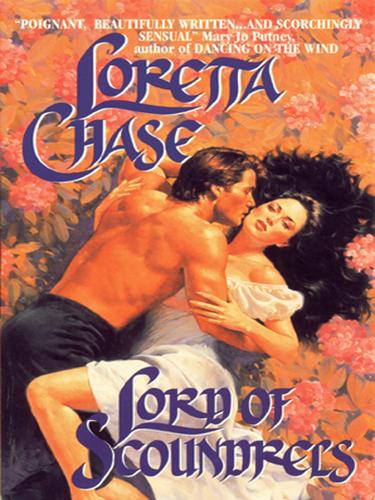
A kind of heroine does not exist nearly enough in romance fiction: the one who is not afraid of him. Not recklessly brave, not secretly trembling while she pretends otherwise — genuinely, constitutionally unimpressed by a man the rest of the world finds terrifying, because she has assessed him accurately and found something worth engaging with under all the armor. That heroine is rare. When she exists, she tends to produce the kind of love story that readers return to for decades. Loretta Chase created that heroine in Jessica Trent, and paired her with Sebastian Ballister, and the result is one of the finest historical romances ever written.
Sebastian, the Marquess of Dain, has spent his entire life ensuring no one looks at him clearly. He is large and scarred and deliberately awful, and it has worked perfectly until Jessica walks into a Parisian antique shop and begins treating him like a puzzle she intends to solve at her leisure. Chase built Lord of Scoundrels on that collision, and on the particular dynamic that emerges when a man who has made himself unlovable meets a woman who cannot be intimidated into pretending she agrees with his self-assessment.
What Chase does in this book that places it permanently in the conversation about the best historical romances ever written is refuse to make the hero’s redemption easy. Dain is not redeemed by love; he is confronted by it, which is harder and more interesting. Jessica does not fix him. She holds a mirror up until he can no longer avoid what he sees, and the book trusts the reader enough to let that process take the time it takes. The wit in Chase’s dialogue is famous for good reason — but it is the emotional precision underneath the wit that makes the book impossible to forget.
Dain’s self-assessment is worth examining as a character choice. He is not wrong about everything — he is genuinely difficult, genuinely scarred, genuinely capable of being awful. What Jessica refuses is the final verdict he has rendered on himself, the conclusion that these qualities are everything rather than a response to a history that shaped them. Her refusal is not naivety. It is a more accurate reading of him than he is capable of making himself, and that accuracy is what the book is about.
The sharp, quick-exchange dialogue that defines this book is one of those cases where audio can go either way — when the narrator captures Chase’s comedic timing, it is a genuine pleasure, so a quick sample before committing is worth the time.
Readers who want to stay in the Regency space with a similarly outmatched-hero dynamic should follow a thread to Lisa Kleypas’s Devil in Winter, where another disaster of a man meets his match in a woman he completely underestimates. For the pleasure of a woman who refuses to be frightened of a man who frightens everyone else, Judith McNaught’s Whitney, My Love offers a broader canvas with that same fundamental dynamic at its center.
Lord of Scoundrels is on every best-of-historical-romance list for the same reason certain books simply stay: because it got something right that most novels only gesture toward. Two difficult people, fully rendered, finding their way to each other without either of them becoming less themselves. That is harder than it sounds. Chase made it look effortless.
Chase’s broader catalog rewards exploration for readers who want to stay in her particular register — the historical wit, the strong heroines, the heroes who are difficult in ways that are specific and earned rather than generically brooding. The Carsington Brothers series, beginning with Mr. Impossible, offers her romantasy sense of adventure applied to a more exotic setting. Silk & Shadows is an earlier work that shows her command of the dangerous hero done at a different scale. All of them carry the same quality: the reader is always aware that Chase trusts both her characters and her reader, and that trust is the foundation of everything.
One more note on why this book specifically has held its canonical status for thirty years: Chase understood that the wit and the emotional depth had to arrive in the same sentence, not in alternating modes. The funniest lines in this book are also the most emotionally precise. The moments of genuine vulnerability are also frequently the funniest. That integration is the rarest thing in romance writing, and the reason readers come back to this book after rereads and find it holds up. A book that makes you laugh and breaks your heart simultaneously, with the same words, is a very difficult thing to write. Chase did it, and the genre has never quite stopped talking about it.