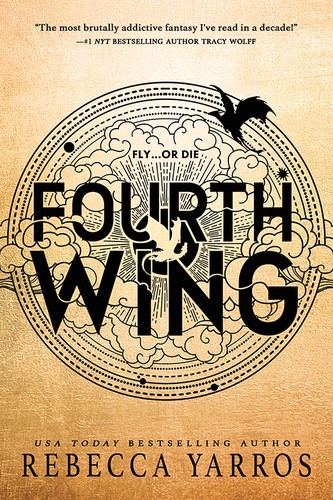
A particular kind of tension only exists when the person you are falling for has a practical, documented reason to let you die. Not indifference — something more complicated than that. An obligation, a history, a set of circumstances that should make them your enemy, and yet something keeps happening in the space between you that neither of you chose and neither of you can seem to stop. Rebecca Yarros understood that tension exactly when she built Fourth Wing, and she ran it at full scale.
Violet Sorrengail arrives at Basgiath War College as the smallest person in the room and the one with the most reasons to fail. Yarros builds the world around a brutal logic: the weak do not survive, and Violet has been told her whole life that she is fragile. What happens when she isn’t is the emotional engine of the book — and Xaden Riorson, who should want her dead for reasons that become clear slowly, is the most compelling witness to what she actually is.
Yarros writes action the way the best romance authors write tension: as a delivery mechanism for the thing underneath. Every battle, every training sequence, every near-death moment is really about two people deciding, again and again, whether to let the other one in. The world is spectacular. The dragons are spectacular. But readers who finished this book in one sitting were not there for the magic system. They were there for the look across a room that meant something nobody was supposed to say yet.
Violet’s arc deserves particular attention. She arrives at the college with a physical reality that the institution was not designed for and a stubborn refusal to treat that as a reason to fail. Her growth through the book is not the standard “discovers she is special” fantasy arc — she was always capable, and the book is about the world’s slow recognition of that rather than her acquisition of power she did not have before. That distinction is part of what makes her a more interesting heroine than the genre average.
Fourth Wing is a genuine audio experience — the scope of the world and the propulsive pacing translate beautifully to narration, and the voice work on Xaden in particular is the kind of thing that makes the commute home feel very short. This is a series that audio enhances rather than simply delivers.
The enemies-to-lovers dynamic here — lethal stakes, forced proximity, the question of who is protecting whom — also runs through Sarah J. Maas’s A Court of Thorns and Roses, where a heroine is similarly dropped into a dangerous world and discovered by the last person who should care what happens to her. For readers who like the forbidden-love stakes without the fantasy setting, Ana Huang’s Twisted Love offers a contemporary version of a man with documented reasons to stay away from a woman he cannot stop watching.
What Fourth Wing understands is that nothing makes a love story more intense than the possibility that it should not exist at all — that the world has arranged itself so that these two people should be on opposite sides, and they keep ending up in the same room anyway. That is not just a dragon-rider problem. That is a very human one, told here at the fullest possible scale.
The Iron Flame, the second book in the series, continues directly from where Fourth Wing ends and is best read in sequence — the cliffhanger that closes the first book is genuine, and waiting between them is not recommended. Yarros built a series with significant forward momentum across books, and the emotional payoffs are compounding rather than self-contained. Readers who fall into this world tend to fall quickly and deeply, and the second book is already available for the fall.
A note on the romantasy genre as it exists now: Fourth Wing arrived at a moment when the category was establishing itself as a mainstream rather than niche phenomenon, and it has become one of the defining works of that consolidation. Understanding what it does exceptionally well — the combat sequences as emotional delivery mechanisms, the world-building as pressure system, the enemies-to-lovers arc as structural spine — gives a reader a useful framework for understanding what distinguishes the best romantasy from the category’s more generic entries.